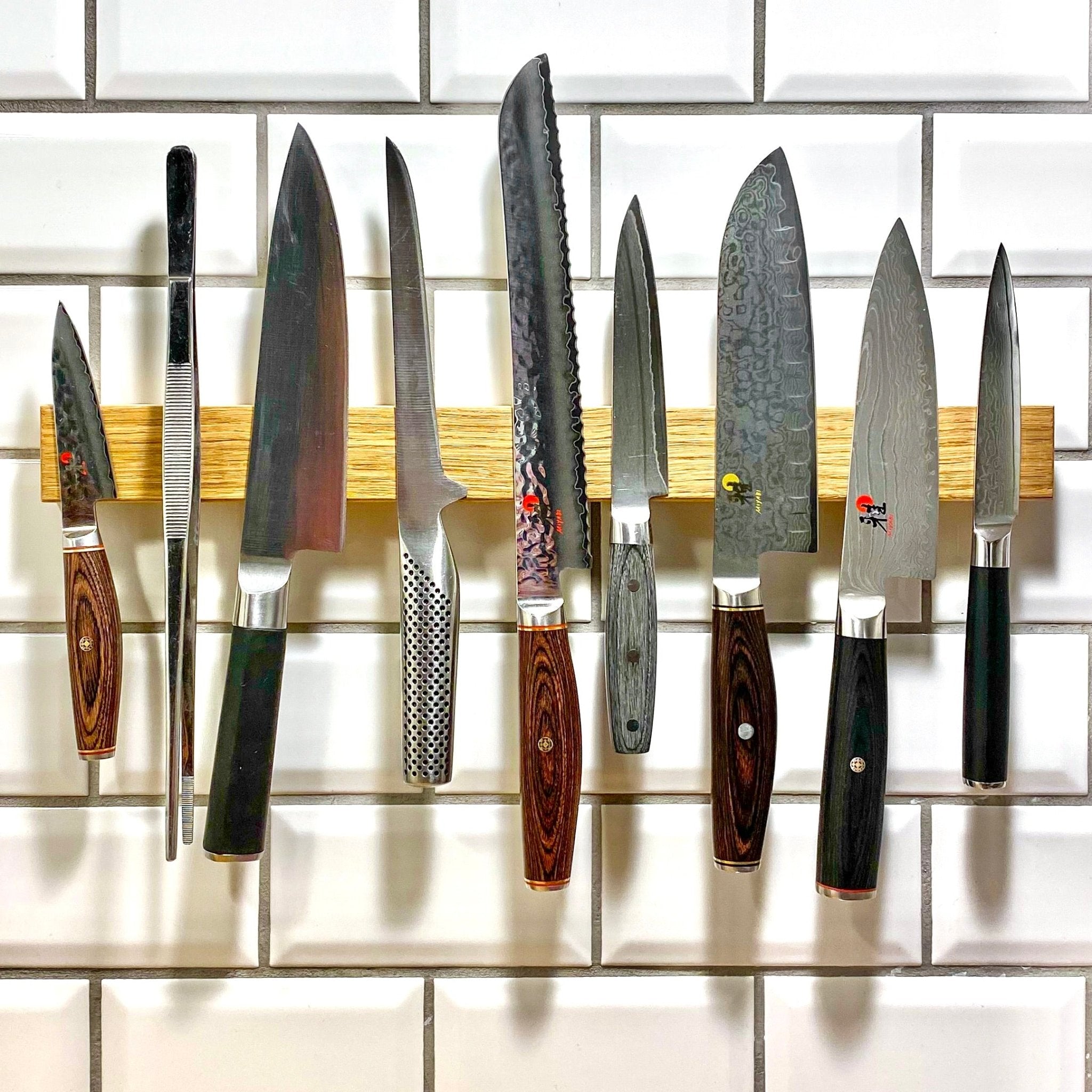
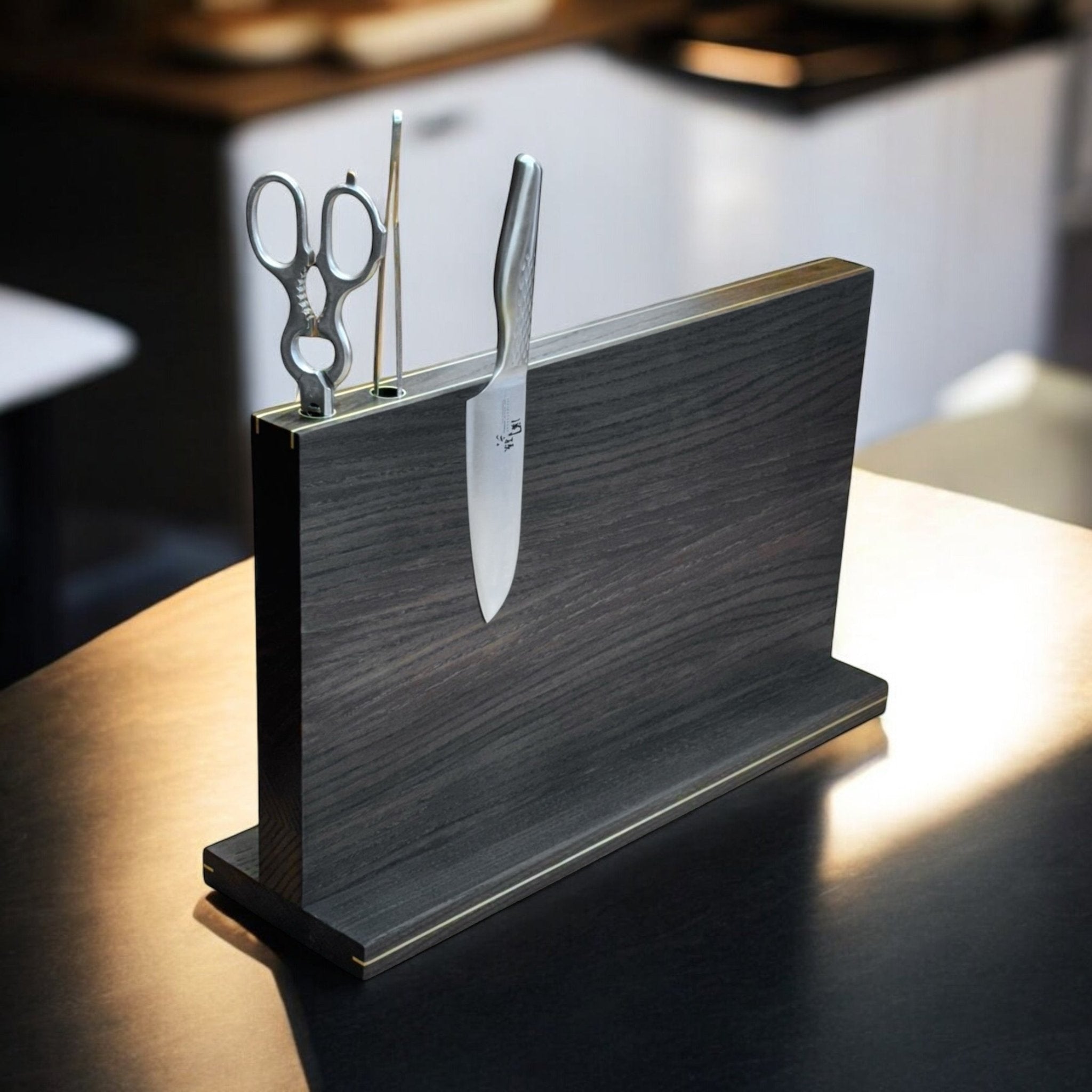
Can all kitchen knives hang on a magnetic knife holder?
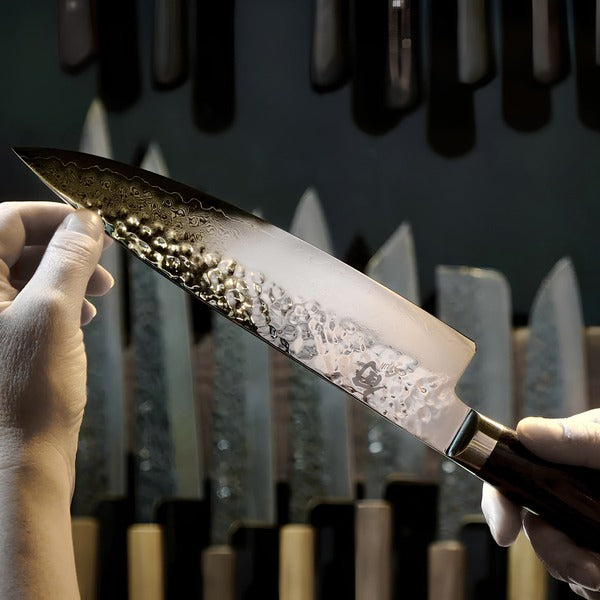
Most common kitchen knives made of hardened steel can be hung on a properly sized magnetic knife rack. However, “steel” is not a single magnetic category, and therefore there are knives that are attracted noticeably weaker than others.
If you want to know if a particular knife fits a particular holder, you need to look at both the blade material and the holder's construction – not just the weight of the knife.
Stainless steel can be very different
The British Stainless Steel Association divides stainless steels into structural families with different magnetic properties. Ferritic, martensitic and duplex grades are generally magnetic, while fully austenitic grades in the annealed condition may have low magnetic permeability.
Many knife steels are hardened martensitic alloys and therefore respond well to magnets. However, kitchen knives can also have layered constructions, surface coatings and alloys that change the practical attraction.
A home test can tell a lot
If you are in doubt, a regular fridge magnet can provide a simple indication. If it is clearly stuck to the blade surface, the knife will typically also respond to a magnetic holder. However, the test does not say exactly how large a safety margin a particular rail has.
Heavy cleavers, very long knives or unusually weakly magnetic blades should therefore be tested on the specific holder rather than assessed based on a general rule.
The distance to the magnet counts
K&J Magnetics documents that the holding force decreases when there is a physical gap between the magnet and the steel. Wood, leather, linoleum or other front covering is therefore part of the magnet construction and must be considered in the design.
A well-designed wooden holder compensates for the front material with magnet placement, magnet geometry and number of contact points. Therefore, two visually identical rails can have very different functions.
The knife must also be able to be removed safely
Too much force can make the removal unnecessarily abrupt, while too little force gives too little safety margin. The good solution is a controlled balance, where the knife sits stably and can be tilted free with a natural movement.
The short answer
For the vast majority of quality knives made of hardened steel, magnetic storage is not a problem. However, for very heavy or unusually weakly magnetic knives, you should check the specific combination – and choose a holder with the appropriate strength and contact surface.
See magnetic knife holders and knife blocks . See our Japanese kitchen knives .
Convenient to remember
Knives with very special materials require extra attention. Ceramic knives are not ferromagnetic and therefore cannot be held by a regular magnetic rail. A steel knife with a thick non-magnetic coating can theoretically be placed further away from the magnetic part, but on regular laminated kitchen knives the layers are typically so thin that the overall response of the steel is still relevant. Folding knives, scissors and other tools should only be hung on the rail if the manufacturer has considered their use and if they are stable. Never use a magnetic holder as evidence of steel quality: the fact that a knife is strongly attracted says something about magnetic properties, but not directly about hardness, corrosion resistance or cutting ability.
If you are unsure about a particular blade, ask the manufacturer about the knife model, length and weight. This provides a much better basis than guessing based on the steel name alone.
Sources and further reading
- British Stainless Steel Association: Magnetic Properties of Stainless Steels
- BSSA: Magnetic Properties of Austenitic Stainless Steels
- K&J Magnetics: Magnets vs. Steel
- K&J Magnetics: Steel Thickness and Magnetic Fields