What does HRC mean on a kitchen knife? Hardness in practice
HRC is an abbreviation often found in the specifications of kitchen knives. The number is a measurement on the Rockwell C scale and is used as a practical expression of the hardness of the steel after heat treatment. It is useful – but far from a complete gradebook for a knife.
A knife with a hardness of 62 HRC is therefore not automatically “better” than a knife with a hardness of 58 HRC. Hardness affects wear resistance and deformation, among other things, but the geometry of the knife, steel quality, heat treatment and the way it is used are at least as important.
How is HRC measured?
ASTM E18 describes the Rockwell method as an indentation test: an indenter is pressed into the material under defined loads and the depth of penetration is converted into a hardness number. The measurement is made at a specific point and does not in itself represent all properties of the entire blade.
It is also important that two different steels at the same HRC can behave differently. Chemical composition, carbides and heat treatment process have an impact on strength, toughness and wear.
Why are Japanese knives often harder?
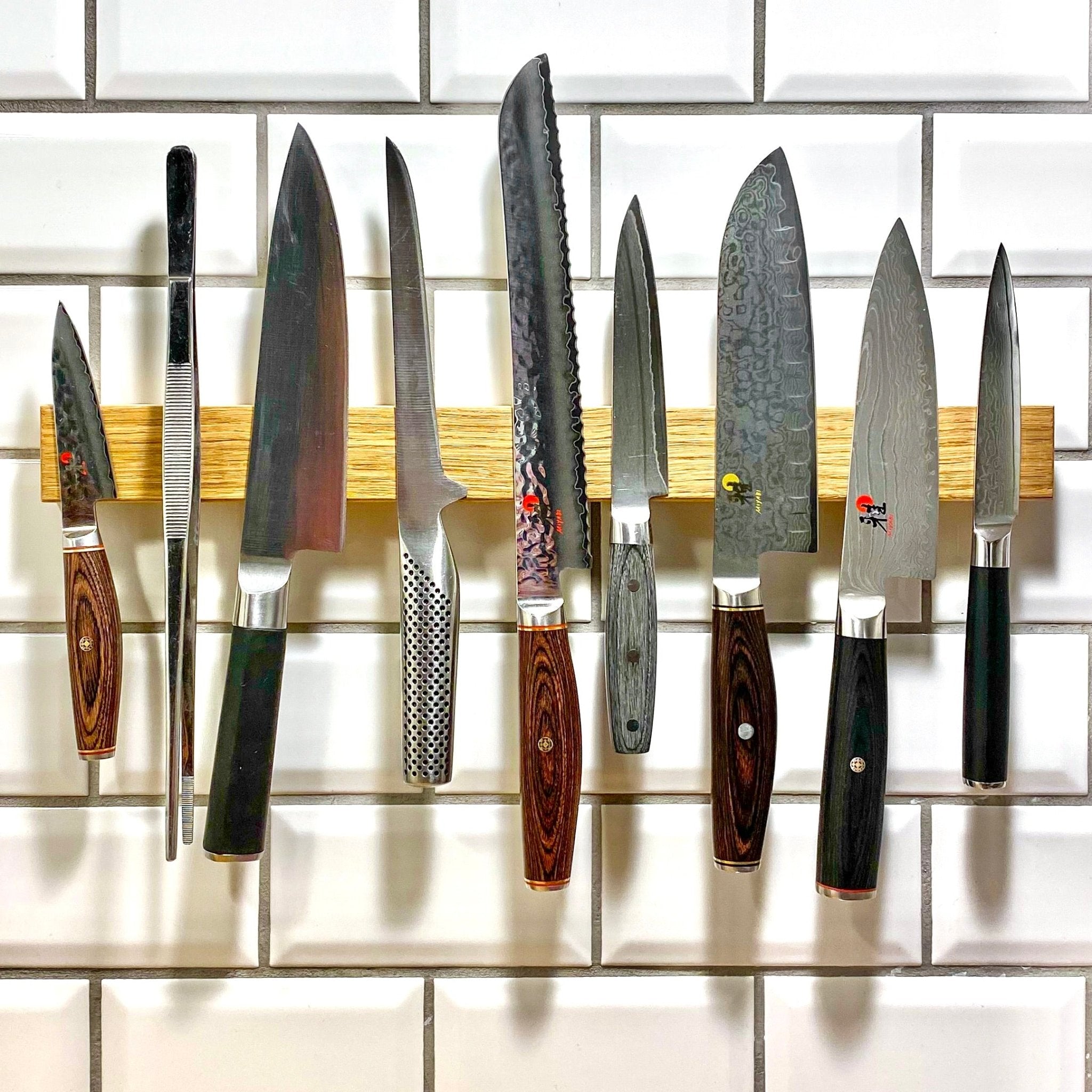
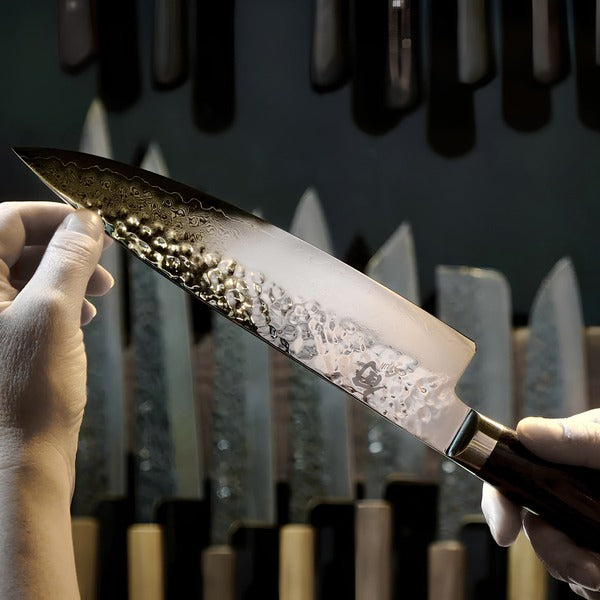
Many Japanese kitchen knives are relatively thin and sharpened to a sharper geometry. Manufacturers such as Korin and ZWILLING generally describe Japanese knives as harder and thinner than classic German knives. The higher hardness can support a thin, precise edge and good edge retention.
However, the same combination means that the knife should typically not be exposed to twists, frozen produce, or hard bones. A hard, thin egg can get micro-chips if used as a heavy all-purpose tool.
HRC and grinding
A higher HRC number does not necessarily mean that the knife is difficult to sharpen, but highly wear-resistant steels may require more work or appropriate abrasives. At the same time, a harder edge can often hold its shape longer during normal cutting.
The sharpening angle of the knife is also crucial. A smaller angle gives a more cutting geometry, but makes the edge itself less robust. Therefore, HRC should always be read in conjunction with the knife type and application.
A practical interval – not a checklist
Many quality European knives are in the high 50s on the HRC scale, while many Japanese knives are in the 60s and above. There are exceptions in both directions, so use the specification as information about design choices – not as a ranking system.
The short answer
HRC is useful when you want to understand how a knife is constructed. But don't choose a kitchen knife based on hardness alone: the best combination is the one that suits the raw materials, cutting technique, maintenance, and the robustness you actually need.
See Japanese kitchen knives . Compare Gyuto, Santoku and Nakiri .
Convenient to remember
When comparing two knives, HRC is best used as context. A thin vegetable knife with a 62 HRC rating may be designed for precise cuts in soft ingredients, while a more robust chef’s knife with a 58 HRC rating may be chosen to withstand greater variation in use. One design is not necessarily more serious than the other. Also, be aware that the manufacturer’s HRC number is often given as a range, because heat treatment and measurement have tolerances. So ask not only “how hard is the knife?” but also “how thin is the blade, what type of steel is used, and what is the knife intended for?” This gives a much more realistic picture of its capabilities in the kitchen.
Sources and further reading
- ASTM E18: Rockwell Hardness of Metallic Materials
- Korin: Japanese Knife FAQ
- ZWILLING: Japanese vs. German Knives
- Shun: Knife FAQ