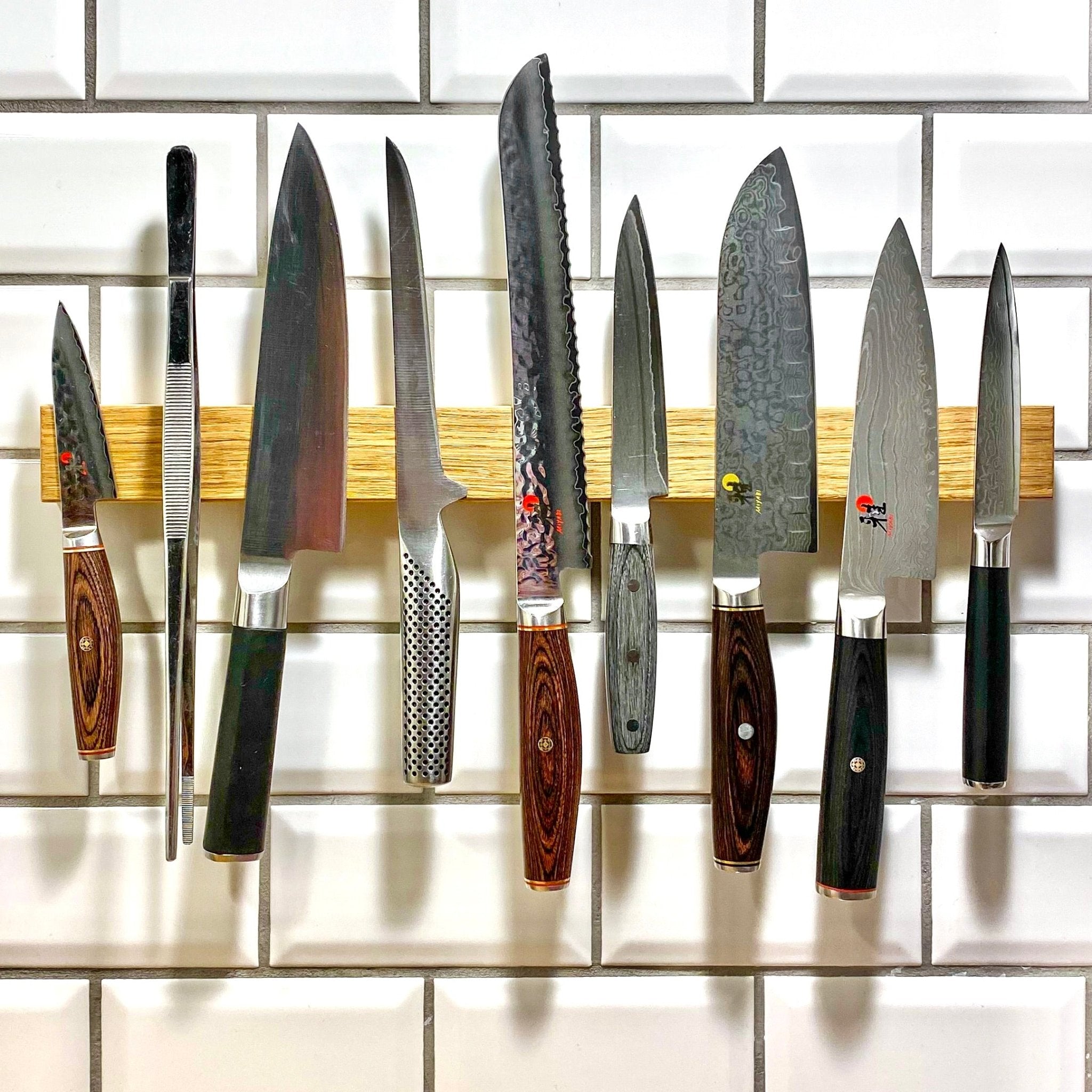
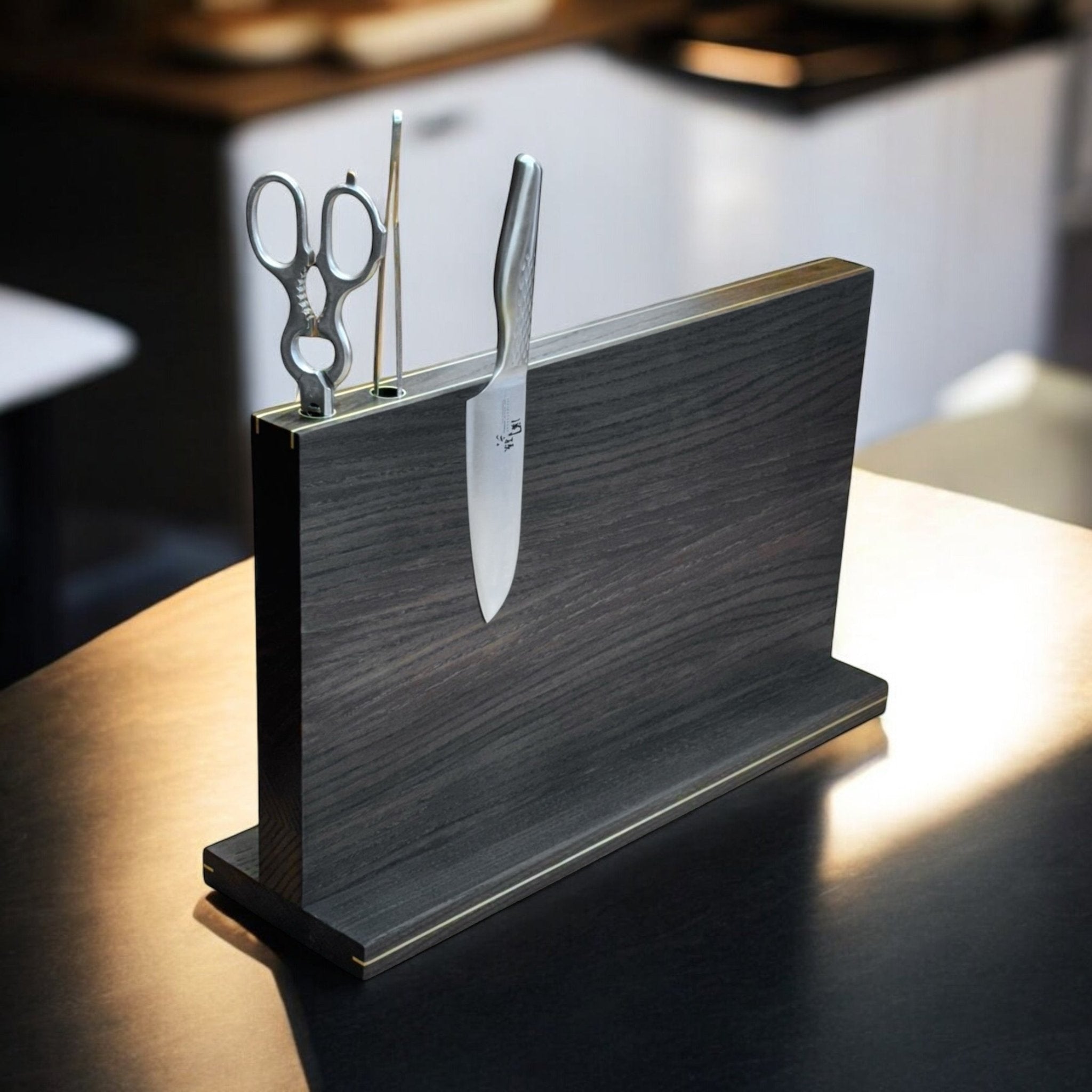
Magnetic knife block on the table or magnetic knife holder on the wall?
A magnetic knife block and a wall-mounted knife rack solve the same problem in two different ways: they keep knives visible and separate, but they each use up a different amount of kitchen space. Therefore, the best solution is often determined by the layout before it is determined by the knives.
Both solutions can work very safely when the magnet strength, contact surface and location are correctly dimensioned. The difference lies mainly in flexibility, table space and mounting.
The magnetic knife holder frees up table space
A rail on the wall uses space that is often otherwise empty. This makes it ideal for small kitchens or workstations where countertop space is at a premium. At the same time, the length can be chosen according to the width of the knife collection and future needs.
The disadvantage is that the rail requires a suitable wall and a location where the knives can be removed without hitting wall cabinets, shelves or other objects.
The knife block can be moved
A freestanding magnetic block requires no wall mounting and can be moved if the kitchen workflow changes. This is handy in rental homes or on kitchen islands where wall space is far away.
On the other hand, the block takes up table space. It should stand stably, and the tips and handles of the knives should have free space so that they can be put on and taken off in a controlled manner.
Magnetism is the same basic physics
Regardless of whether the magnets are in a block or a rail, the holding force is affected by the distance, the properties of the steel and the contact area. K&J Magnetics shows that both the gap and the size of the steel can significantly change the force.
This means that the quality of the construction is more important than the format alone. A block is not automatically stronger than a rail, and vice versa.
Think about your biggest knife
When choosing a solution, don't just measure the number of knives. Also look at the longest blade, the heaviest knife, and the width of the largest blades. For example, a long sujihiki requires more clearance than a compact santoku.
Position the holder so you can grip the handle naturally and remove the knife without sideways scraping.
The short answer
If you have a free wall and want to preserve table space, a magnetic knife holder is often the most effective solution. If you want to avoid assembly or be able to move the storage, a magnetic knife block is more flexible. Functionally, both can be equally good.
See magnetic knife blocks and magnetic knife holders . Read the magnetic knife holder selection guide .
Convenient to remember
Cleaning also calls for looking at the specific construction. An open magnetic block or rail has visible contact surfaces that can be wiped clean, while traditional knife blocks with deep slots can be more difficult to inspect. This does not mean that a magnetic solution is “hygienic in itself”: the knives must still be clean and completely dry before being put away. In family kitchens, the location should also be assessed in relation to children and passage. A wall rail can be placed high, but the handles must still be ergonomically accessible to the person using them. A table block can be moved, but should not be placed close to an edge where it can tip over. Safety is therefore as much about location as it is about format.
Measure the available space with your largest knives in hand before choosing a format. This often reveals the best solution quickly.
Sources and further reading
- K&J Magnetics: Magnets vs. Steel
- K&J Magnetics: Steel Thickness and Magnetic Fields
- British Stainless Steel Association: Magnetic Properties