A ceramic figure is not just a ceramic figure
A bird in ceramic can be many things.
It can be lifelike or almost abstract. Colourful or subdued. Industrially made or hand-decorated. A small ornament, a collector's piece or a genuine sculpture in the room.
At Les Céramiques de Lussan the starting point is remarkably simple.
A guinea fowl.
A quail.
A little hen.
But behind the simple forms lie decades of work with proportions, glazes, colours and craft – and a ceramic tradition carried on in the same family studio since the 1970s.
That is precisely why we chose Les Céramiques de Lussan for Rune-Jakobsen Design.
Not because they try to make the most detailed ceramic bird – but because they have removed almost everything superfluous.
The story begins with Heidi Caillard
Heidi Caillard was born in Basel, Switzerland, in 1932. From 1949 to 1954 she studied art at the Kunstgewerbeschule in Basel and in 1962 continued her training at the ceramics school in Lausanne.
In 1968 she settled in Blauzac near Uzès in the south of France and opened a small pottery workshop with an adjoining showroom.
In 1971 Heidi and her husband Daniel Caillard bought a run-down country property in Lussan. In the middle of the extensive restoration, the workshop and shop moved there in 1974.
That was the beginning of the workshop known today as Les Céramiques de Lussan.
The guinea fowl did not begin as a product
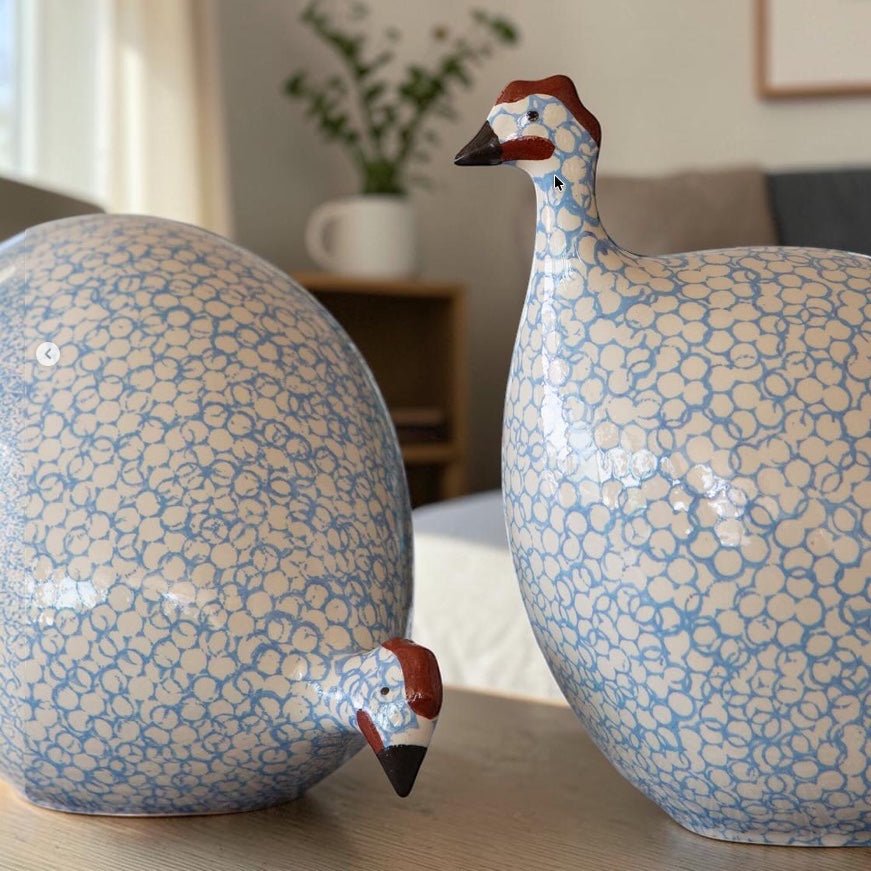
The best-known figure is without doubt Pintade – the guinea fowl.
The idea came to Heidi during her student years. Real guinea fowl lived in her own garden, and the bird's characteristic body and plumage became the starting point for the ceramic interpretation.
But the final form did not come at once.
According to the workshop's own history, the development required long periods of sketches, building up, breaking down and new attempts before the proportions had the desired balance.
That is interesting, because at first glance the Pintade looks almost self-evident.
A round body.
A small head.
A short neck.
Two legs.
But precisely when a form is reduced that strongly, the proportions become decisive.
There is very little to hide a bad line behind.
Stylised rather than lifelike
Many ceramic animal figures try to render fur, feathers, eyes and anatomical details as lifelike as possible.
Les Céramiques de Lussan go in the opposite direction.
The Pintade is clearly a guinea fowl, but it does not try to imitate every single feature of the living bird.
The body is reduced to a calm volume.
The neck to a simple line.
The head to almost a graphic point.
The characteristic feathered look is created not by modelled feathers but by the surface's mouchetage – the spotted decoration.
That gives the birds a special ability to work in very different interiors.
They are figurative without becoming naturalistic.
Decorative without becoming ornamental.
And humorous without becoming caricatured.
The comparison with Lladró shows the difference clearly
Spanish Lladró represent an entirely different – and very impressive – tradition in ceramic figurative art.
Lladró's figures are made in porcelain at the company's workshop in Valencia. Production involves extensive modelling, casting, manual assembly, hand painting and a palette of several thousand colours. Complex models can consist of hundreds of separate parts.
It is an extremely detailed approach.
Lussan do almost the opposite.
Where Lladró often seek detail, narrative and technical complexity, Lussan seek the silhouette.
The bird must be recognisable in a few lines.
Neither approach is necessarily better.
They simply represent two very different ideas of what a ceramic figure can be.
Handmade does not necessarily mean rustic
The term handmade is used very broadly.
At Les Céramiques de Lussan it does not mean that every bird is modelled entirely from scratch without any kind of production system.
Over the years the workshop has structured manufacture so the figures can be produced consistently and delivered internationally.
When the son Adrien Caillard took over the business in 1994, he organised and streamlined production and packaging, among other things.
But according to the company, the manual processes that directly concern the object itself were kept.
That is an important distinction.
Craft does not have to mean that every product starts without a method.
It means that people still have a decisive role in the finished result.
From red clay to finished bird
The workshop itself describes the process as from the earth to the object.
The starting point is red clay, which in the workshop is turned into animals, figures and various ceramic objects. Production still takes place in the workshop at Lussan.
RJD's Pintade, Caille and Poulette are shaped in clay and finished with glaze and hand decoration.
It is above all the last part that gives the birds their individual character.
Mouchetage – the dots are not just decoration
The guinea fowl's natural plumage is full of small pale spots.
At Les Céramiques de Lussan this trait is reduced to the characteristic mouchetage.
Small marks are laid over the base colour and create the pattern that has become one of the workshop's most recognisable hallmarks.
Because the decoration is done by hand, the dots are never entirely alike.
They do not sit in exactly the same place.
They are not identical in size.
And the colour can vary slightly from bird to bird.
The maker themselves therefore point out that product photos are only indicative: the handwork means both colours and mouchetage can vary.
That is not something you should try to sort out.
It is precisely part of the product.
Two identical birds are not quite identical
When industrial products are made, the aim is normally to reduce variation.
Product number 5,000 should look like product number 5.
In handmade ceramics, variation can be a quality.
Two Pintades in the same size and colour combination will resemble each other.
But place them side by side and you will typically discover small differences in glaze, pattern and expression.
That is enough for the bird to be experienced as an individual object without the identity of the design disappearing.
It is a balance we like at Rune-Jakobsen Design.
Recognisable design – without industrial uniformity.
See the Pintade from Les Céramiques de Lussan at Rune-Jakobsen Design
Colour changes the whole figure
One of the strengths of the very simple form is that colour takes on unusually great importance.
The same Pintade can appear almost classic in a pale base with cobalt-blue mouchetage.
In terracotta with pale marks it gets a far more earthy expression.
Black, grey, burgundy, green and blue can change the character again.
The workshop also works with both traditional and matt surfaces. The maker describes several of the matt versions as a way of giving classic colour combinations a more contemporary expression.
The form does not change.
But the object does.
That is why the birds also work in modern rooms
It is perhaps one of the most interesting qualities of Lussan.
The story is French and rural.
The motif is a bird from the farmyard.
The material is ceramic.
And production has its roots in the 1970s.
Yet a Pintade can sit naturally on a minimalist sideboard, a modern kitchen island or a simple wall shelf.
In our view that is first and foremost due to the graphic form.
There is not much decorative noise.
From a distance you first read the silhouette.
Then the colour.
Only when you come closer do you discover the variations in glaze and mouchetage.
Pintade – the iconic one
The Pintade is the figure associated with Lussan more than any other.
At Rune-Jakobsen Design it comes both in the classic upright position and in a version where the bird bends forward and pecks.
The different heights make it possible to use one bird as a single object or to combine several sizes.
One large Pintade can work almost like a small sculpture.
Several together create something else.
Then they start to look like a little flock.
Caille – the smaller quail
Caille is the workshop's quail and has the same reduced form language as the Pintade, but in a smaller format.
That makes it easier to place on smaller shelves, in window sills or together with other objects.
At RJD the Caille comes in both upright and bent-forward positions and in various hand-decorated colour combinations.
A single one works as a discreet object.
Three or five together become almost a composition.
And because the decoration varies from bird to bird, a group is never completely uniform.
See the Caille from Les Céramiques de Lussan
Poulette – another interpretation of the same form language
Poulette is the little hen in the series.
Here too the anatomy is reduced to a few recognisable elements, while glaze and hand-painted marks give character.
At Rune-Jakobsen Design the Poulette comes in several sizes and colours, from discreet off-white variants to darker or burgundy models.
Pintade, Caille and Poulette are not identical variations on the same form.
But they share a clear visual language.
That makes them interesting to combine.
See the Poulette from Les Céramiques de Lussan
Les Céramiques de Lussan versus Quail Ceramics
British Quail Ceramics are another interesting point of comparison.
Quail likewise work with hand-painted animals and birds, but the approach is considerably more naturalistic and often functional.
The range includes animal-shaped vases, jugs, egg cups, salt and pepper sets and jars. The products are designed in Britain, while the company works with family businesses in Thailand and Sri Lanka for firing and hand painting.
Quail often let the animal's details and personality dominate.
Lussan reduce them.
At Quail a hare can still clearly resemble a particular hare.
At Lussan the bird approaches a symbol.
It is this reduction that makes Lussan's form language so recognisable.
Les Céramiques de Lussan versus Bordallo Pinheiro
Portugal likewise has a long tradition of ceramic animals.
Rafael Bordallo Pinheiro's ceramic universe from Caldas da Rainha is full of fish, birds, frogs, snakes, insects, vegetables and flowers.
Here the work is deliberately with modelled reliefs, surface texture and often an almost overwhelming naturalism.
It is ceramic storytelling.
Lussan is something else.
Where Bordallo can build a whole ceramic universe around leaves, animals and textures, Heidi Caillard's Pintade can almost be reduced to one continuous curve.
Both traditions start from nature.
They end up in very different places.
Restraint can be a strength
Les Céramiques de Lussan could of course have developed hundreds of different animals.
The workshop has not.
The range is broader than just the three birds, but the Pintade is still the clear centre of the company's identity. The official shop today holds a very extensive selection of Pintades in different sizes, colour combinations and surfaces.
In our view that is a strength.
Design identity does not necessarily arise from constantly inventing something new.
Sometimes it arises from working on with the same form until it becomes recognisable without a logo.
A Pintade from Lussan does not need a big mark on its side.
You can see what it is.
From small workshop to internationally known design
When Adrien Caillard took over the work in 1994, production and packaging were structured so the ceramicists could deliver to professional customers.
Participation in Maison & Objet in Paris and many years of coverage in interior and design media helped make the small workshop internationally known.
In 2000 the workshop was extended by a further 200 m² or so.
But production remains tied to the studio at Lussan, and the company still describes manufacture as artisanal.
It is precisely the balance between repetition and handwork that makes the products interesting.
Many Pintades are made.
But they do not become completely identical.
Why Les Céramiques de Lussan at Rune-Jakobsen Design?
There is excellent ceramic figurative art from many makers.
Lladró demonstrate how technically detailed and refined handmade porcelain can be.
Bordallo Pinheiro show the expressive, naturalistic tradition of Portuguese figurative ceramics.
Quail Ceramics combine hand-painted animals with humour and functional everyday objects.
Les Céramiques de Lussan interest us for a different reason.
They have taken a very simple idea and refined it over decades.
The round body.
The small head.
The characteristic silhouette.
The colour.
And the hand-painted mouchetage.
There is hardly more than that.
But there does not need to be more.
It fits well with our own approach to products at Rune-Jakobsen Design:
The material should be visible.
The craft is welcome to be felt.
And an object does not have to be complicated to have character.
Handmade in France. Small natural variations. A form that has become an icon in itself.
See the whole Les Céramiques de Lussan collection at Rune-Jakobsen Design
Sources and further reading
- Les Céramiques de Lussan – the workshop's history, Heidi and Adrien Caillard and the development of the Pintade.
- Les Céramiques de Lussan – official description of artisanal production at the workshop in Lussan.
- Les Céramiques de Lussan – product information on handmade Pintades, colours, mouchetage and natural variations.
- Rune-Jakobsen Design – Pintade, Caille, Poulette and the Les Céramiques de Lussan collection.
- Lladró – official description of handmade porcelain production, modelling, casting, assembly and hand decoration in Spain.
- Quail Ceramics – the company's own description of design, hand painting and production with family businesses in Thailand and Sri Lanka.
- Museu Bordalo Pinheiro – the history of Rafael Bordallo Pinheiro's naturalistic, figurative ceramic tradition.
Read also
- Les Céramiques de Lussan – ceramics from a village in the south of France
- Handmade ceramics: the differences between stoneware, earthenware and porcelain
- Dorte Visby – Danish ceramics, materials and craft