A pepper grinder is not just a pepper grinder
A pepper grinder has, on the face of it, one simple task: to turn whole peppercorns into freshly ground pepper.
But the way it happens varies considerably.
Some mills use ceramic grinding mechanisms. Others use hardened steel. Some are operated by turning the whole top, while others use a crank handle, an electric motor or constructions developed specifically for very high capacity.
Makers such as Peugeot, Zassenhaus and MÄNNKITCHEN each represent their own approach to the task. Peugeot works with hardened steel mechanisms and precise adjustment, Zassenhaus with ceramic mechanisms, while MÄNNKITCHEN's Pepper Cannon is built for very high capacity.
Alexander Handcrafted Mills take a different route.
Here a mechanical grinding construction is combined with solid metals, a crank handle and a design language that has far more in common with traditional kitchen tools than with modern industrial kitchen equipment.
That is precisely why we chose them for Rune-Jakobsen Design.
Handmade in Greece since 1977
Alexander Handcrafted Mills was founded in 1977 by H. Ioannou and G. Zarkadis, both with a background as mechanical engineers.
The company has produced pepper, salt and coffee mills in Greece from the start and has exported them internationally since the early 1980s. Production still takes place in Thessaloniki.
What is interesting is the combination of craft and mechanical engineering.
Alexander themselves describe production as automated where it makes sense, but still under personal control and with hand finishing and quality control as a central part of the process.
So this is not a nostalgic product living on its looks alone.
The mill is first and foremost a mechanical tool.
It starts with the grinding mechanism
The most important part of any pepper mill naturally sits inside.
Alexander use their so-called 3DCut system, in which the peppercorn is first gripped and broken, then cut into smaller pieces and finally passed through the smaller teeth to the chosen grind.
On many of the company's pepper mills the mechanism is made of tool steel and can be adjusted from fine to coarse. Several models use mechanisms around 38 mm in diameter, depending on the size of the mill.
That does not mean Alexander is the only maker that works seriously on how the peppercorn is broken.
Peugeot, for example, describe their hardened steel mechanism as a construction that first cracks and then grinds the peppercorn. Peugeot also give a lifetime guarantee on the manual mechanisms.
The difference therefore does not lie in a claim that only Alexander can grind pepper correctly.
The difference lies in the whole mechanical construction around the grinding mechanism.
The crank handle makes a difference
A classic wooden mill is typically operated by holding the body and turning the upper part of the mill.
On many models Alexander use a crank handle.
That gives a different movement.
Instead of turning two relatively large parts against each other, you rotate the mechanism via an arm with a larger radius. Alexander themselves highlight the long arm as a construction that makes grinding easier.
It is a simple mechanical principle: a longer arm gives more torque around the shaft.
But it also changes the experience of using the mill.
You are not just turning a lid.
You are operating a small piece of mechanics.
Solid metal instead of a hidden inner construction
Many classic quality mills are made of wood.
Peugeot's iconic Paris series, for example, is made mainly of beech and combined with the maker's steel mechanism. Zassenhaus likewise offer a long line of models in beech, oak, walnut and other materials with a ceramic mechanism inside.
Alexander have a different material character.
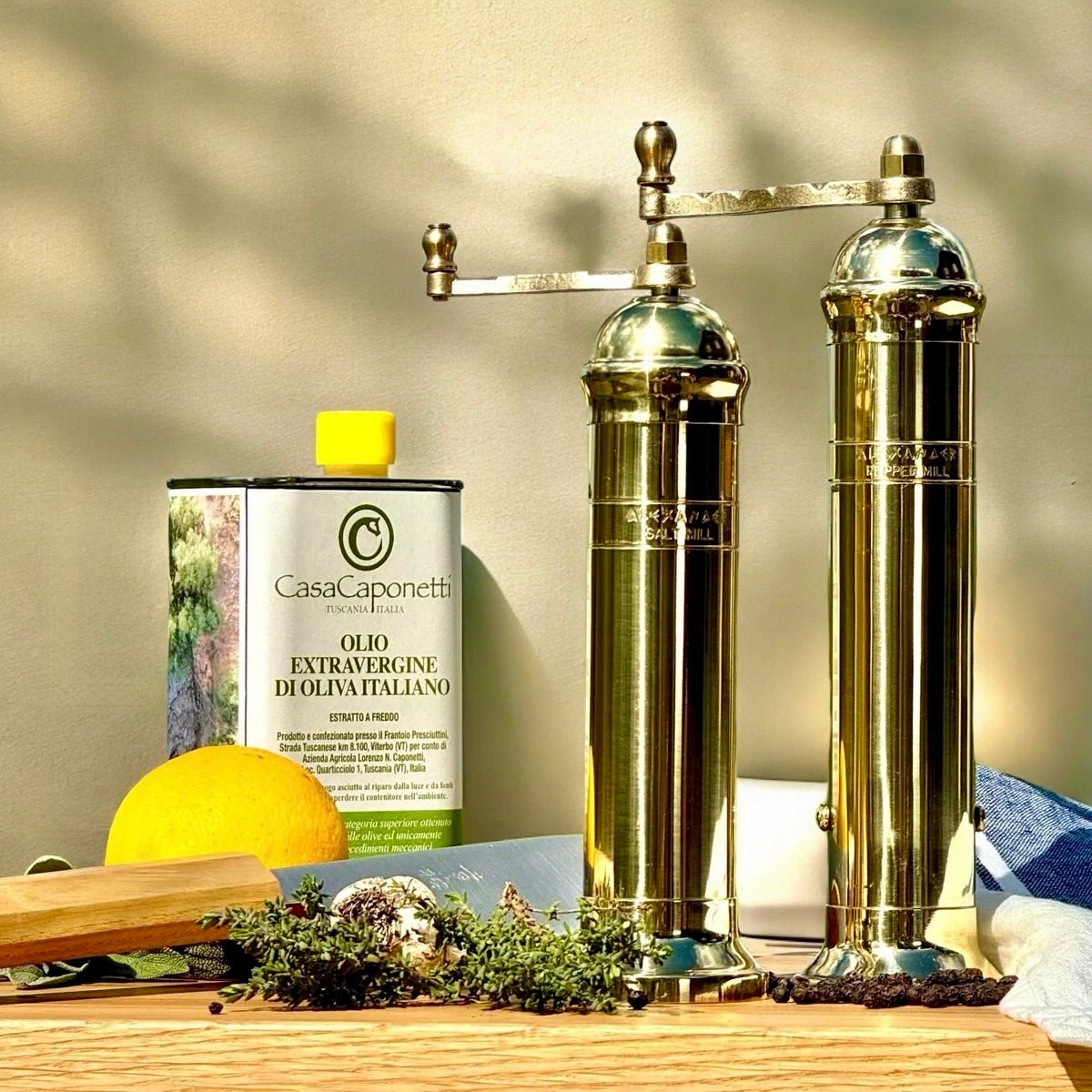
In RJD's range you will find mills in solid brass, copper and chrome-plated brass, among others. The chrome-plated models are still built on a brass construction beneath the surface.
You feel it immediately when you pick one of the mills up.
A 20 cm Alexander model with a metal mechanism can weigh around half a kilo. That gives the mill a marked physical weight and a completely different character from a light wooden or plastic construction.
Weight is not automatically the same as quality.
But here it is a direct result of the materials and the construction.
Brass and copper become more beautiful with use
Brass and copper are living materials.
A polished brass mill looks one way when it is new.
After months and years of handling, air and ordinary use, the surface gradually changes character and develops a natural patina.
In Rune-Jakobsen Design's Alexander range we describe precisely this change as part of the material's properties. If you prefer the polished surface, the brass can be polished up again.
That is a significant difference from many lacquered, anodised or powder-coated kitchen products.
Here there is no attempt to keep the product visually unchanged.
The traces of use are welcome to become part of it.
Patina or polished finish – both are possible
There are basically two ways to live with brass and copper.
You can let the surface develop naturally and accept the darker, more varied patina.
Or you can polish the metal at regular intervals and restore a brighter look.
That makes the mill interesting as an object, because the owner largely decides how it ages.
In that way the Alexander mills have more in common with copper pans, brass fittings and other traditional metal objects than with a typical kitchen appliance.
Pepper and salt do not necessarily need the same mechanism
One important detail is easily overlooked when salt and pepper mills are bought as a matching pair.
Salt and pepper place different demands on the mechanics.
Alexander's pepper mills use a metal mechanism, while the salt models use a separate construction with corrosion-resistant components, because salt is far more aggressive towards ordinary metal. On specific Alexander models the salt mechanism consists of a glass-reinforced food-grade polymer combined with a stainless steel shaft.
Peugeot follow the same basic principle and likewise use different mechanisms depending on whether a mill is intended for pepper, dry salt or moist sea salt.
In our view that is the right approach.
A salt and pepper mill do not need the same mechanism to look like a pair.
Function comes first.
More than black pepper
The Alexander pepper mills can also be used for a range of dried spices.
In RJD's range we recommend them for pepper, coriander seed, fennel, cumin and cardamom among others, depending on the model and the size and hardness of the spice.
That opens up a different way of using the mill.
A smaller Alexander need not be the traditional pepper mill by the hob, for instance. It can be dedicated to coriander seed or a particular spice blend you use often.
Whole spices generally keep their aroma better than pre-ground ones, and the mill lets you grind them just before use.
Alexander versus Peugeot
Peugeot is an obvious point of comparison.
The French brand has a long history with spice mills and still makes several of its well-known wooden models in France. Their steel mechanisms are proven, precise and come with a lifetime guarantee. The u'Select models also have six defined grind settings.
If you want a classic wooden mill with highly controllable adjustment, Peugeot is therefore a strong choice.
Alexander offer something else.
The mill is more of a solid metal object. The crank handle changes the operation, the surface changes over time, and the mechanical construction is very evident in both use and appearance.
That is not necessarily better for everyone.
But it is markedly different.
Alexander versus Zassenhaus
Zassenhaus again represent a different technical philosophy.
The company uses a ceramic mechanism, produced in Germany, that can be used for pepper, salt, spices and dried herbs on a range of models. The grind can be set from very fine to coarse, and the chosen setting is kept when the mill is refilled.
That makes Zassenhaus a flexible solution.
Alexander have more specialised mechanisms for pepper and salt respectively and combine them with a heavy, metal-based construction.
Again, the difference is not a question of one technical solution being right and the other wrong.
They simply build on two different ideas of how a spice mill should be constructed.
Alexander versus the Pepper Cannon
At the opposite end we find MÄNNKITCHEN's Pepper Cannon.
It is CNC-machined in aluminium, has hardened steel teeth, a double-bearing shaft and a very wide grind range. The whole construction is developed with a focus on speed, precision and very high capacity.
It is modern engineering with a clear purpose.
Alexander is also an engineered product – but from a different tradition.
Here the mechanical function is wrapped in brass and copper, a crank handle and a construction that visually could have stood in a kitchen generations ago.
Where the Pepper Cannon almost signals professional precision tool, Alexander signals classic mechanics.
Both can grind pepper.
They simply tell two entirely different stories about what a kitchen tool can look like.
A design with historical roots
The traditional Alexander models build on a type of portable coffee mill associated with the field kit of Greek soldiers.
The basic form is simple: a cylindrical metal body, a visible mechanical shaft and a crank handle on top. Alexander have carried the principle over to modern pepper, coffee and spice mills.
That also explains why the classic models do not look like the traditional French wooden mill.
The design simply has a different starting point.
Classic or Nordic?
The traditional Alexander mills have characteristic decorations and chasing in the metal.
At Rune-Jakobsen Design we also wanted a version with a simpler expression.
That is why Nordic Brass Mill and Nordic Copper Mill are made specially for Rune-Jakobsen Design with smooth sides and clean lines, but with the same basic construction and craft principles as Alexander's other mills.
It changes the character of the mill quite a lot.
The Classic models clearly show their Greek and traditional origins.
The Nordic models let the material stand almost alone.
Brass is brass.
Copper is copper.
Not much more is needed.
See the Nordic Brass Mill at Rune-Jakobsen Design
A mill is welcome to stay out
As with our own cutting boards and magnetic knife holders, we are interested in kitchen tools that do not need to be put away after use.
The Alexander mills are a good example.
They are functional enough to belong by the hob and characterful enough to stand on the dining table.
The solid brass or copper makes them visible objects in the kitchen, and because the material changes with use, each mill gradually becomes more personal.
That fits our basic view of kitchen tools:
What you use every day is welcome to be worth looking at.
A product that can be maintained
Alexander treat the mills as mechanical tools.
The maker's programme includes maintenance and spare parts, and the constructions are developed so the mechanism can be cleaned and serviced rather than the whole product necessarily being discarded if something needs attention after many years of use. The maker has separate categories for maintenance, accessories and spare parts.
That is a quality we appreciate.
A tool made of solid metal should not be regarded as a short-lived consumable.
It should be used.
Maintained.
And used again.
Why Alexander Handcrafted Mills at Rune-Jakobsen Design?
There are excellent spice mills from other makers.
Peugeot make some of the world's best-known wooden mills with thoroughly proven steel mechanisms.
Zassenhaus have developed a flexible and precise ceramic system.
MÄNNKITCHEN demonstrate how far a pepper mill can be taken when high capacity and mechanical precision are prioritised over almost everything else.
Alexander Handcrafted Mills are interesting for other reasons.
They combine mechanical function, solid metal, craft, tradition and a design that becomes more beautiful and more personal with use.
They do not try to look like a modern kitchen appliance.
And they do not try to hide that they are mechanical tools.
The crank, the shaft, the metal and the grinding mechanism are all part of the product's identity.
That is exactly what we like about them.
Handmade in Greece. A precise grinding mechanism. Solid brass and copper. Materials that develop a patina over time.
A kitchen tool for those who prefer real craft to mass production.
See all Alexander Handcrafted Mills at Rune-Jakobsen Design
Sources and further reading
- Alexander Handcrafted Mills – official maker information on company, production and range.
- Alexander Handcrafted Mills – technical specifications for the 3DCut mechanism and metal mechanisms.
- Rune-Jakobsen Design – Alexander Handcrafted Mills, materials, models and use.
- Rune-Jakobsen Design – Nordic Brass Mill, made specially for RJD.
- Peugeot – steel mechanism, u'Select and grinding principles.
- Zassenhaus – ceramic mechanism and adjustment.
- MÄNNKITCHEN – Pepper Cannon, construction and grind range.
Read also
- Pepper mills that grind – not crush
- Salt mill vs pepper mill – is the mechanism different?
- How to choose the size and height of a pepper mill