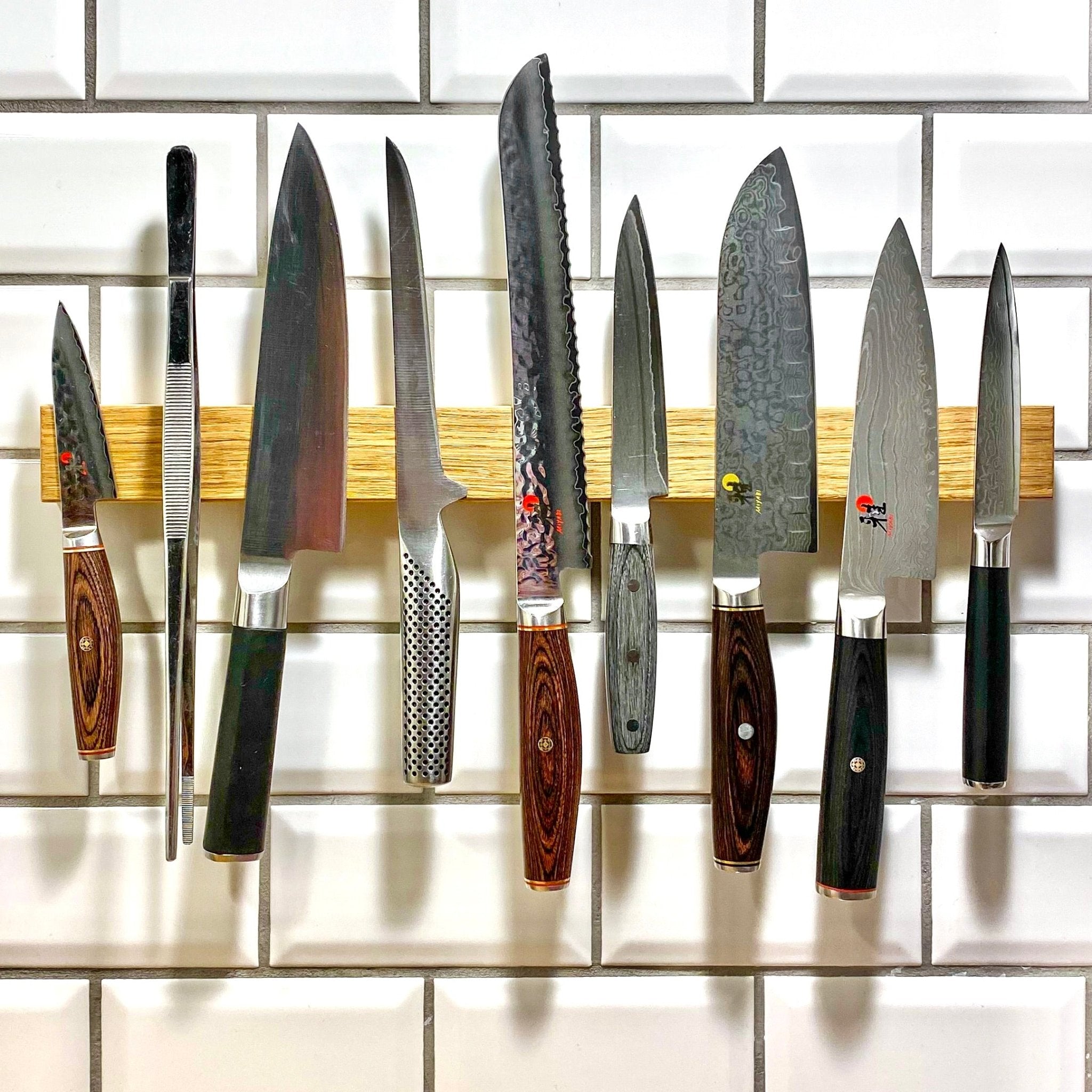
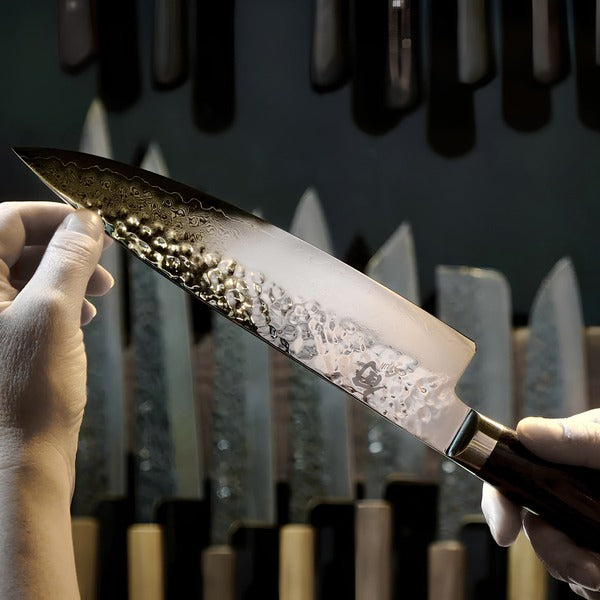
A magnetic knife holder is not just a magnetic knife holder
At first glance the principle is simple: a magnetic knife holder should hold your kitchen knives securely on the wall.
Look more closely at the construction, though, and there are considerable differences in how magnetic knife holders are made. The type and placement of the magnets, the distance between magnet and blade, the front material, the dimensions of the holder and the manufacturing method itself all affect both function and appearance.
At Rune-Jakobsen Design we have worked with magnetic knife storage for more than 10 years. Our view is that a magnetic knife holder should not merely be strong. It should be correctly magnetised, pleasant to use and shaped as a permanent part of the kitchen's interior.
Different makers – different solutions
The market ranges from industrial magnetic strips in metal and plastic to wood-clad holders and handmade models in solid wood.
WÜSTHOF, for example, offers acacia magnetic knife holders in fixed lengths of 30 and 50 cm among others. They are described as space-saving knife storage with extra-strong magnets; the current acacia model is made in China.
Bisbell – one of the pioneers of magnetic knife storage – makes a very wide range in aluminium, silicone, oak, acacia and walnut among other materials. Their wooden solutions use traditional magnetic strips, and the models are typically produced in set standard lengths.
There are also makers closer to RJD's craft-based approach. Danish Noyer, for instance, hand-makes walnut magnetic knife holders using five small neodymium magnets per knife position. Austrian Rohleder combines solid wood, neodymium magnets and vegetable-tanned leather. American Heirloom Products offers both custom sizes and different magnet strengths.
None of these features is therefore unique in itself.
The difference lies in how they are combined.
Full magnetism rather than fixed positions
One of the most important construction differences between magnetic knife holders is how the magnets are placed inside the holder.
In Rune-Jakobsen Design's holders we use continuous rows of strong neodymium magnets along the full length. The magnets are hidden inside the material and distributed so that a blade is acted on by several magnets at once.
That means the knives do not have to be placed on specific magnet points.
The whole length can be used.
A 40 cm holder typically takes 6–8 kitchen knives, depending on blade width and the spacing you prefer. The continuous magnetisation also gives several contact points on each blade, which helps prevent the knife pivoting around a single magnet point.
It is a fairly invisible difference.
But it is one you notice every day.
More magnetic force is not always better
A common assumption is that the best magnetic knife holder is simply the one with the strongest magnets.
It is not that simple.
The magnetic force must be sufficient to hold the knife stably, but the knife must also come off the holder in a controlled way and without unnecessary force.
That is why Rune-Jakobsen Design makes holders with different magnet strengths.
The narrow models of 4.5–8.5 cm are sized for the vast majority of ordinary kitchen knives. The wide models from 10 cm have roughly 50 % more magnetic force, while our Ekstra models have around twice the pull of the standard models.
That makes it possible to choose a holder for the knives that will actually hang on it – rather than using one magnet strength for every purpose.
See RJD's extra-strong magnetic knife holders: Extra-strong magnetic knife holders – Rune-Jakobsen Design
4.5 cm or 20 cm? Width is part of the design too
Many traditional magnetic knife holders are shaped as a narrow strip.
That works fine – and RJD makes narrow models too. But there is no technical reason why a magnetic knife holder has to look like a strip.
That is why our holders come in both narrow and very wide formats.
The wide models give a larger visual surface where the structure of the oak or walnut becomes far more prominent. The larger surface also allows more rows of magnets and thus higher magnetic force. Models of 10 cm or more are chamfered on the back, so the holder appears slightly lifted from the wall with a discreet shadow around the edge.
The magnetic knife holder thereby changes from a technical strip into something closer to a small piece of wall-hung furniture.
See RJD's wide magnetic knife holders
Wood is not the only surface
Solid wood is an obvious material for a magnetic knife holder, because it is both beautiful and relatively gentle on the blade.
But we work with other surfaces as well.
RJD's Leather Protected models have a leather front. Colors uses linoleum, and Cork has a front of natural cork. The materials change the tactile experience, the contact between knife and holder and the visual expression.
Rohleder is an example of another maker that also places leather in front of the magnets, so the idea of a protective leather front is not unique to RJD. The difference is that at RJD it forms part of a larger system of narrow, wide and extra-strong models plus alternatives in linoleum and cork.
See magnetic knife holders with leather, linoleum or cork
When the metal is a detail – not the magnet
Magnetic knife holders are often associated with a visible metal strip.
On several RJD designs we turn the principle around.
In Split, for example, the holder itself is made of solid wood, while a narrow detail in brass, copper or aluminium is inlaid as a graphic element.
The metal inlay sits slightly below the wood surface and therefore never touches the blade. It has no function as a magnet – its function is aesthetic. The magnets remain hidden inside the wood.
That makes it possible to work with the contrast between oak, smoked oak or walnut and, say, brass or copper without turning the holder into a metal strip.
From standard product to custom size
Another significant difference lies in the dimensions.
WÜSTHOF, for example, offers its wood-based magnetic holders in set standard lengths, while Noyer works with 25, 40, 60 and 80 cm. Rohleder's leather-clad model comes in 30 and 50 cm.
At Rune-Jakobsen Design several of the narrow models range from 30 to 120 cm and are also available in several widths. The Wideboard series likewise comes in a wide range of dimensions, and minor deviations from standard sizes can be made to the customer's wishes.
Other makers, including Heirloom Products in the USA, also offer custom sizes. Custom production is therefore not a uniquely RJD principle either.
For us it simply follows naturally from the way the products are made:
We do not produce for stock. We make each magnetic knife holder to order.
Handmade in Denmark – from start to finish
Many of the world's best knife makers are, naturally enough, first and foremost knife makers. Knife blocks and magnetic holders are accessories to their main range.
Rune-Jakobsen Design comes from a different direction.
We work as cabinetmakers with wood, surfaces, joints, proportions and finish – and the magnetic knife holder is therefore treated as a product in its own right.
Every holder is made individually to order in our own workshop in Denmark. The wood is machined, sanded, finished and completed by hand, and the magnets are built into each individual holder.
That is also why the range does not consist solely of variations on the same strip.
There are narrow models, wide models, black Blackboard designs, Split with metal inlays, leather, linoleum, cork and particularly strong versions.
The functional principle is the same.
The aesthetic result does not have to be.
Functional kitchen tool or small piece of furniture?
A magnetic knife holder can perfectly well be a simple strip that solves one practical task.
There is nothing wrong with that.
Our ambition is different.
At Rune-Jakobsen Design we regard the magnetic knife holder as a functional piece of kitchen furniture. It must hold the knives securely and make them easy to take – but it must also be able to form a deliberate part of the room's materials and architecture.
That is why we work with different widths, wood types, surfaces, metal details and magnet strengths.
And that is perhaps the most important difference.
Not one magnetic knife holder meant to suit every kitchen and every knife – but a holder that can be chosen and made for the kitchen and the knives it will actually be used with.
See all magnetic knife holders from Rune-Jakobsen Design
Sources and further reading
- WÜSTHOF – Magnetic Holder, Acacia.
- Bisbell Magnets – Knife Storage and Magnetic Wooden Knife Rack.
- Noyer Denmark – Magnetic Knife Rack, Walnut.
- Rohleder – Magnetic Knife Rack, wood and leather.
- Heirloom Products – Custom Magnetic Knife Holder.
- Rune-Jakobsen Design – product and collection information on construction, magnet strength, materials, dimensions and manufacturing.
Read also
- How strong should a magnetic knife holder be? More is not always better
- Magnetic knife holder: narrow or wide model – which should you choose?
- Magnetic knife holder in wood, leather or linoleum – advantages and differences