Which pot should you choose for pasta, sauce and simmering dishes?
It's tempting to choose pots based on their liters alone. But shape, diameter and height are just as important in determining how the pot functions. A tall eight-liter pot and a wide four-liter sauté pan can both be useful – for completely different tasks.
When you choose a pot by cooking method instead of by set, you often end up with fewer but more usable parts.
For pasta: volume and space
For pasta, a relatively large pot is practical because there needs to be room for both water, pasta and stirring without boiling over. A tall stockpot type makes efficient use of the hob area and provides large capacity without extreme diameter.
If you often only have one or two portions, the pot doesn't need to be huge. Choose a size that fits the amount you're actually cooking so you don't heat up a lot of metal and water unnecessarily.
For sauce: less volume and good control
A saucepan has high, relatively straight sides and a long handle. It is suitable for small amounts of liquid, heating, reduction and sauces. Made In describes sauce as a typical task for the saucepan format.
A saucier has more rounded sides. Serious Eats highlights that the curved transition makes it easier to reach with a whisk and reduce sauces without sharp corners. Either type can be good – the shape changes the working experience.
For simmering dishes: surface and lid
For braising and simmering dishes, a wider pot or sauté pan is often handy. The larger base gives you room to brown ingredients before adding liquid, while a tight-fitting lid reduces evaporation during long cooking.
If the dish is primarily soup or stock, high volume is more important than a large frying surface. Therefore, a stockpot and a wide braiser are not really competitors – they are different tools.
The material also matters
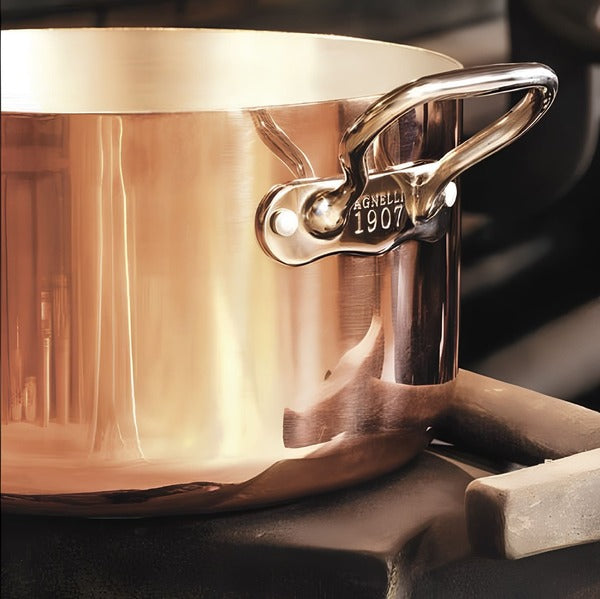
Multi-layer stainless steel with a heat-conducting core is versatile because it can withstand browning and can go straight into liquid-based cooking. Copper-based constructions provide faster temperature response, while thick aluminum is efficient and lightweight for professional use.
Always check compatibility with your hob, especially if you use induction.
The short answer
For pasta: prioritize capacity. For sauce: prioritize control and a shape you can work in precisely. For simmering dishes: prioritize sufficient bottom surface, stable heat and a good lid. It's a more useful method than buying all pots in the same size or series.
See pots and pans from Pentole Agnelli . See 3-ply steel cookware .
Convenient to remember
Handles and lids are also worth considering. A small saucepan with a long handle is easy to lift and pour from, while a large stockpot is safer with two short side handles. For a heavy simmer, two handles can be an advantage when moving the pot from stove to oven or table. A lid significantly affects evaporation: for a stock, you may want controlled reduction without a lid, while a braised dish often needs to retain more moisture. Also think about storage. Three carefully selected pots – for example, a smaller saucepan, a medium-sized all-purpose pot and a large pasta pot – can be more useful than a large set of many almost identical sizes.
Sources and further reading
- Made In: Saucepan vs. Pot
- Serious Eats: Saucepans vs. Sauciers
- Serious Eats: Best Stockpots
- All-Clad: Cookware types and materials