3-ply vs. 5-ply vs. copper – which cookware should you choose?
More layers doesn't automatically equal better cookware. And copper isn't automatically the right choice just because the material is expensive. What matters is how the layers are constructed, how thick the cookware is, and how you cook.
Pentole Agnelli works with several multi-layer constructions. At Rune-Jakobsen Design we carry, among others, 3-ply Alu-Inox, 5-ply Alu-Inox and a 4-layer copper construction. They have different strengths – and all three are made for serious cooking.
Why combine multiple metals?
Stainless steel is robust, food-safe and relatively easy to maintain, but conducts heat less well than, for example, aluminum and copper. Aluminum conducts heat efficiently and is lightweight. Copper responds quickly to changes in heat input. Multi-layer cookware therefore combines materials so that each part of the construction solves a specific task.
It is the layer materials and the total thickness – not the number alone – that determine the practical difference.
3-ply Alu-Inox – 2.5 mm and relatively light
Agnelli's 3-ply construction consists of an inner surface of 18/10 stainless steel, a layer of Al1050 aluminum and an outer surface of high-iron stainless steel. The total thickness is 2.5 mm.
The aluminum core distributes heat, while the outer shell makes the cookware induction compatible. The construction is less massive than 5-ply and is therefore a good choice if you want professional multi-ply construction without the added weight and thermal mass of a 4 mm construction.
5-ply Alu-Inox – 4 mm and more mass
The 5-ply series is built with 18/10 stainless steel on the inside, three layers of aluminum – Al1050, Al3003 and Al1050 – and a high-iron stainless steel exterior. The total thickness is 4 mm.
The larger amount of material means more thermal mass. In practice, the temperature changes less abruptly when a cold ingredient is placed on the pan, and the cookware feels more stable under load. The downside is more weight and a slightly slower response when you turn the heat up or down significantly.
4-ply copper – response and another work tool
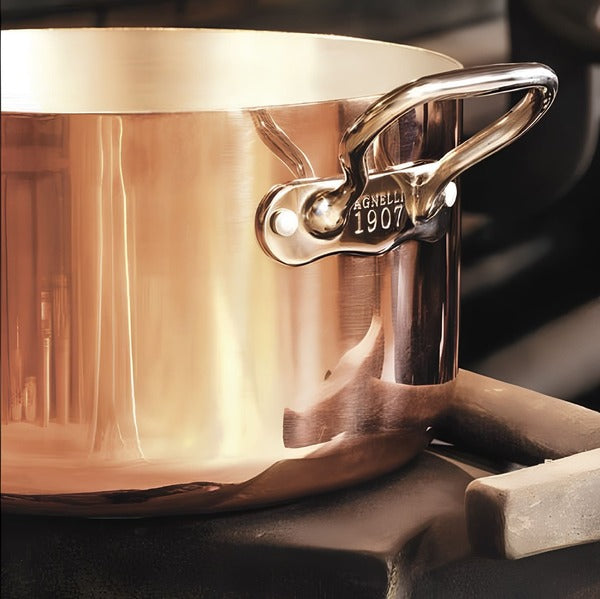
Agnelli's copper series is a four-layer construction of 2.5 mm: 18/10 stainless steel on the cooking side, aluminum, a high-ferrous layer for induction and copper on the outside.
Copper has high thermal conductivity and is therefore associated with a rapid response to changes in heat. In a multi-layer construction, this property is combined with stainless steel on the inside and a ferromagnetic layer, so the series can also be used on induction.
The surface of copper, however, changes with use. If you want the shiny, warm copper color, the exterior requires more cosmetic care. If you accept the patina, ongoing maintenance becomes simpler.
Which series is best?
Choose 3-ply if you want a relatively light and fast-reacting piece of multilayer cookware for everyday use.
Choose 5-ply if you prioritize greater thermal mass, temperature stability, and a more solid feel – and don't mind the extra weight.
Choose copper if you want the special response and classic copper expression and accept that the outside will either get a patina or need to be polished.
Induction: all three can be used
Induction requires a magnetic layer that can couple to the hob's field. In the specific Pentole Agnelli designs this is built in, also in the copper series. You therefore do not have to choose 3-ply or 5-ply solely for induction reasons.
Our most important advice
Don't choose by a number on the packaging. Compare the actual layering, thickness, weight and the cooking you're actually doing. A good 3-ply pan is not a downgraded 5-ply pan; it's a different tool.
See 3-ply , 5-ply and 4-ply copper from Pentole Agnelli .
Sources and further reading
- Rune-Jakobsen Design: Pentole Agnelli 3-layer Alu-Inox
- Rune-Jakobsen Design: Pentole Agnelli 5-layer Alu-Inox
- Rune-Jakobsen Design: Agnelli 4-layer copper pot
- All-Clad: Cooking on Stainless Steel for Beginners