Aluminum vs. Stainless Steel vs. Copper for Cookware
The material of a pan affects how quickly heat moves from the hob through the bottom and sides. This is why aluminum, stainless steel and copper feel different in use – even when two pans are the same size.
It is also important to distinguish between the internal food contact surface and the material that transports the heat. Modern multi-layer cookware combines materials to achieve multiple properties in the same construction.
Aluminum: high thermal conductivity and low weight
Aluminum conducts heat much better than regular stainless steel and is also relatively lightweight. This makes the material effective when a pan needs to respond quickly to changes in the flame and distribute heat over a larger surface area.
There are both raw aluminum constructions and solutions where aluminum is the core between layers of other metals. In a multi-layered pan, aluminum can therefore provide heat distribution without being the inner surface.
Stainless steel: robust food contact surface
Stainless steel is corrosion-resistant, mechanically robust and relatively neutral towards food, but it conducts heat worse than aluminium and copper. Therefore, pure, thin stainless steel is not in itself the most even heat distributor.
All-Clad and other manufacturers use bonded constructions, where stainless steel is combined with aluminum. The result is a durable surface and a more heat-conducting core.
Copper: very fast and even heat transfer
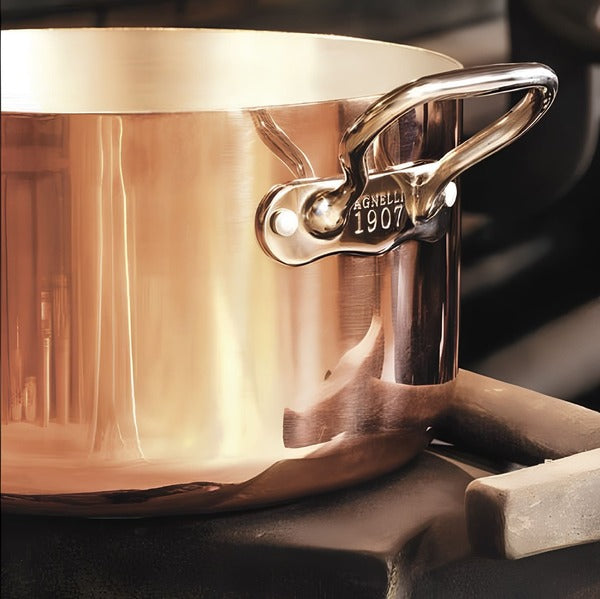
Copper has very high thermal conductivity and responds quickly to changes in energy input, which is one of the reasons why copper has traditionally been used for precision cookware.
Copper pots for modern cooking usually have an inner lining or a multi-layer construction so that the food does not come into direct contact with reactive copper. The material is also heavier and more expensive than aluminum.
Multi-layer construction is a deliberate compromise
3-ply, 5-ply and copper cores are not about “more layers are always better.” The construction determines how much heat-conducting material there is, where it is located, how heavy the pan becomes and how quickly it responds.
The relevant question is therefore not just the name of the material, but the entire structure: thickness, core, surface, base and compatibility with the hob you are using.
The short answer
Aluminum provides high thermal conductivity for its weight, stainless steel provides a robust work surface, and copper provides very high thermal response. The best designs don't necessarily choose one material—they use each material where it provides the most benefit.
See Pentole Agnelli cookware . Read more about 4-layer copper . Read about 3-layer Alu-Inox .
Convenient to remember
Thickness is crucial in all three materials. A very thin layer of aluminum cannot be expected to distribute heat like a solid professional aluminum pan, and a very thin layer of copper does not provide the same thermal character as a construction with a real copper core. It is therefore worth reading the specification beyond the words “3-ply” or “copper”. Look for total thickness, material distribution and whether the layers go up the sides or are primarily located at the bottom. On gas, side heat can make fully covered constructions relevant, while a thick sandwich bottom can work excellently on an even electric zone. Induction also requires a magnetically compatible outer layer, because neither aluminum nor copper on their own couple effectively to the induction field.
Sources and further reading
- Cookware Manufacturers Association: Guide to Cookware and Bakeware
- Copper Development Association: Benefits of Copper Heat Transfer
- All-Clad: Cookware Materials
- All-Clad: Cookware Collections and Layered Construction