A pan is not just a pan
A frying pan can look simple.
A base. Some sides. A handle.
But while cooking, it is largely the material and the construction that decide how quickly the pan heats up, how evenly the heat spreads, how quickly the temperature drops again – and how precisely the cook can control the result.
That is exactly where Pentole Agnelli differ from many cookware makers.
Agnelli do not build their whole range around one material, one construction or the idea that one type of pan is best for everything.
The company works with aluminium, stainless steel, multi-layer systems, copper and cast iron, and treats the different thermal properties of the materials as a central part of the cooking itself.
It is an approach we share at Rune-Jakobsen Design.
The right cookware is not necessarily about choosing the most expensive. It is about choosing the construction that best suits what you are going to cook.
More than 100 years of Italian cookware experience
The story begins in Bergamo.
In 1905 the young Baldassare Agnelli encountered aluminium during a period of work in Montenegro. Two years later, in 1907, he set up his metallurgical firm in Bergamo.
At that time aluminium was still a new material in Italian kitchens.
That changed quickly.
During the First World War copper was requisitioned in Italy for military purposes, and aluminium was increasingly used for cookware. In the following decades Agnelli grew with the material, and when the professional Italian restaurant trade expanded rapidly after the Second World War, professional cookware became a central part of the company.
Today Pentole Agnelli are still based in the Bergamo area and produce a very extensive programme of professional cookware. The maker describes the range as developed for both restaurants and ambitious home kitchens.
First the material – then the shape
What is interesting about Agnelli is not only the company's age.
It is the way the company thinks about cookware.
Copper, aluminium, stainless steel, iron and cast iron behave differently when exposed to heat.
Agnelli's own project Oltre il Metallo takes as its starting point precisely the physics between the heat source, the metal and the food. The maker's point is simple: the metal is not just the container around the food. It is an active part of the cooking.
That also means there is no single material that is objectively best for every task.
Some materials respond quickly.
Others hold heat better.
Some are light.
Others are heavy and stable.
And multi-layer systems try to combine several of those properties in the same construction.
Aluminium – the material Agnelli started with
If one material is closely tied to Pentole Agnelli's history, it is aluminium.
That is first and foremost because of the material's thermal properties.
Aluminium conducts heat markedly better than stainless steel. That means the heat is quickly spread away from the area where the flame or heating element hits the base.
The result is fast heating and a relatively even temperature across the cooking surface.
At the same time aluminium is light.
That is an important property in a professional kitchen, where a pan may be lifted, tossed and moved hundreds of times in a working day. Agnelli highlight precisely the combination of high heat conduction, low weight and ease of handling as reasons for aluminium's traditional popularity in restaurant kitchens.
It is not necessarily the most prestigious material.
But it is extremely functional.
And it says a lot about Agnelli.
Professional cookware does not have to be complicated to be good.
Thickness matters
Two aluminium pans are not necessarily alike.
One of the most important differences is material thickness.
A thicker piece of aluminium contains more material to absorb and spread the heat and is also more resistant to deformation.
Agnelli make professional aluminium lines in different gauges, including traditional models in 3 mm aluminium. The maker themselves highlight thickness as a key parameter for both heat distribution and quality.
It is a good example of a detail that can barely be seen in a product photo.
But that can be felt when you cook.
So why not make everything in aluminium?
Because aluminium also has limitations.
Untreated aluminium is not the ideal material for long storage of strongly acidic or salty foods, and ordinary aluminium does not work on induction by itself.
Stainless steel, on the other hand, is chemically robust, easy to maintain and excellent as a food-contact surface – but conducts heat far less well.
That is where multi-layer technology becomes interesting.
3-PLY – three layers of material with different jobs
Agnelli's 3-PLY Alu-Inox combines stainless steel and aluminium.
The construction uses aluminium to carry and spread the heat, and stainless steel as a robust surface and an induction-compatible exterior.
That gives a construction combining a substantial part of aluminium's thermal properties with the advantages of stainless steel.
Agnelli describe 3-PLY as a good compromise between heat conduction, strength, weight and everyday usability.
That is also why a 3-PLY sauté pan is so versatile.
It can be used to brown.
Then to sauté.
Then to add liquid and let the dish simmer on in the same pan.
At Rune-Jakobsen Design we have chosen the Mantecare pan and high sauté pans from this construction, among others, because they represent exactly the kind of Italian cookware where the shape has been developed around the way the food is actually cooked.
Mantecare – when the shape of the pan follows the technique
The Italian word mantecare describes the final stage in which, for example, pasta or risotto is worked together with fat, cheese, sauce or cooking liquid so the dish becomes glossy and creamy.
That requires movement.
So a pan with rounded or sloping sides makes sense.
The ingredients can be moved, tossed and brought together instead of getting stuck in a sharp angle between base and side.
It is a good example of Agnelli's basic approach:
The shape of the cookware should follow the cooking – not the other way round.
5-PLY – when more stability and control are wanted
With 5-PLY the construction is built up from five layers of metal.
Agnelli combine stainless steel with several layers of aluminium, so that aluminium distributes the heat through the construction while the steel layers provide strength, stability, a robust food-contact surface and induction compatibility.
Compared with 3-PLY, the maker describes 5-PLY as more thermally stable and more resistant to deformation, especially in longer or more demanding cooking.
That does not mean five layers automatically make any pan better than a three-layer model.
More material goes into the construction.
That gives different properties.
A 3-PLY can be lighter and more direct.
A 5-PLY can give more mass and stability.
The choice depends on the use.
See Pentole Agnelli 5-PLY at Rune-Jakobsen Design
Agnelli are not alone with 5-PLY
Multi-layer cookware is not an Agnelli invention, and it would be wrong to present it as such.
American All-Clad have for decades been closely tied to bonded cookware and make, among others, the D5 series with five layers of stainless steel and aluminium through the whole body of the pan.
French Mauviel likewise use a five-layer construction in the M'COOK series with stainless steel on the inside, several layers of aluminium and ferritic steel on the outside for induction.
de Buyer Affinity works on a related principle with a five-layer construction of steel and aluminium and is made in France.
So there are several excellent makers of advanced multi-layer pans.
Agnelli's particular strength lies elsewhere.
One brand – several material philosophies
Many premium makers become closely tied to one particular construction.
All-Clad are known for bonded stainless.
Mauviel are historically associated with copper and today also offer excellent multi-layer series.
de Buyer span widely but are strongly associated with French iron and steel products, among others.
Pentole Agnelli have from the beginning had a pronounced material focus.
Within the same professional universe there is aluminium, coated aluminium, stainless steel, 3-PLY, 5-PLY, copper-based Copper4, iron and cast iron. The maker's current programme comprises a very large number of variants, shapes and sizes.
That makes it possible to ask a more interesting question than:
Which series is the best?
The question becomes instead:
Which material and which construction are best for what I am going to cook?
Copper4 – copper without the limitations of the classic copper pan
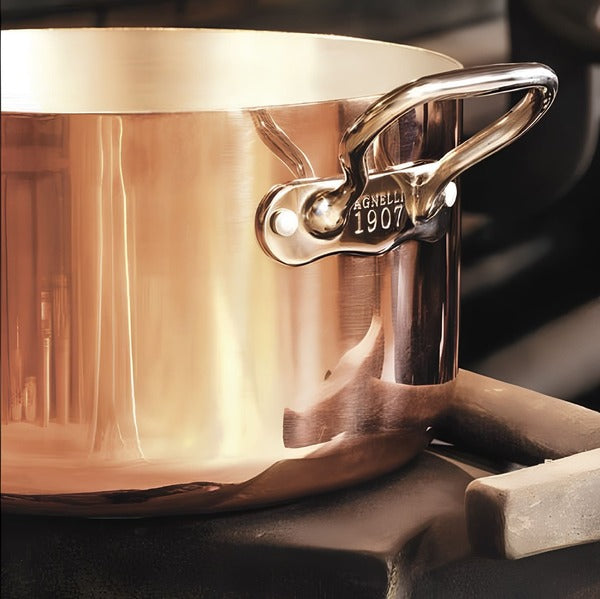
Copper has been valued in professional kitchens for centuries because of its very high heat conduction.
When the heat changes, copper responds quickly.
That lets the cook correct the temperature faster than with materials that store a lot of heat and respond more slowly.
It is especially interesting for sauces, reductions and other preparations where a few degrees can make a big difference.
But traditional copper cookware has its challenges too.
Copper needs a suitable inner food-contact surface, and a classic copper pot does not work on induction as it is.
Agnelli's Copper4 solves the problem by making the copper part of a multi-layer construction together with aluminium and stainless steel.
The result combines copper's fast thermal response with an inner steel surface and a construction that can work on modern hobs – including induction.
Copper you can actually use on induction
In our view that is one of the Copper4 series' most important properties.
It looks like cookware from a classic European copper tradition.
But the construction is modern.
On Agnelli's Copper4 the copper is ground away on the underside so the induction-compatible ferritic steel is exposed towards the cooking zone.
That gives a flat induction base without removing the copper from the rest of the pan's exterior.
So you do not get a historical copper pan that someone is trying to adapt to a modern kitchen.
You get modern multi-layer cookware in which copper is a real part of the construction.
The copper is allowed to show
All-Clad also offer advanced cookware with copper.
Their Copper Core uses five layers with copper as an inner core layer between aluminium and stainless steel. That gives fast heat conduction and precise temperature control, while the exterior of the pan appears mainly as polished stainless steel.
Agnelli choose a different aesthetic direction.
On Copper4 the copper is visible on the outside.
That does not just change the pan's thermal construction.
It changes its whole character.
A Copper4 pan is welcome to hang in view.
The copper becomes darker and more varied with use, and as with other untreated copper the surface can be polished if you want the bright look back.
For us that is part of the material's quality.
Cookware does not have to look unused to be beautiful.
Pentole Agnelli versus Mauviel
Mauviel is a natural point of comparison.
The French company has a long tradition of copper cookware and today makes both classic copper series and advanced multi-layer products.
M'COOK, for example, uses five layers – stainless steel, three layers of aluminium and ferritic steel – and works on induction.
In many ways it is the same basic physics that Agnelli work with.
The difference is rather the range philosophy.
Agnelli make the choice between aluminium, 3-PLY, 5-PLY, stainless steel, copper and other materials a very explicit part of the professional system.
You do not just choose size and shape.
You also choose thermal behaviour.
Pentole Agnelli versus de Buyer
de Buyer is likewise a maker we have great respect for.
The Affinity series is a good example of modern French multi-layer cookware: five layers of stainless steel and aluminium, fast heat distribution, induction compatibility and manufacture in France.
So again:
5-PLY is not in itself Agnelli's particular advantage.
What is interesting about Agnelli is that 5-PLY is just one tool among many.
It is the material-based thinking that sets the brand apart.
Why not non-stick everywhere?
The modern pan market is strongly dominated by non-stick coatings.
That can be practical.
But it is not necessarily the best solution for every kind of cooking.
An uncoated stainless steel surface allows strong browning and the formation of fond – the caramelised residue that can then be dissolved with wine, stock or other liquid and become the basis for a sauce.
It tolerates metal utensils and does not depend on a coating that wears over time.
In return it demands a little more understanding of temperature and fat.
In our view that is not a disadvantage.
It is part of getting to know your cookware.
Professional cookware is allowed to ask something of the user
Good cookware does not necessarily do everything automatically.
A stainless steel pan does not become non-stick just because it is expensive.
A copper pan does not relieve the cook of controlling the temperature.
And five layers of metal cannot compensate for a pan left empty on maximum heat.
Agnelli themselves give detailed recommendations on correct use and stress, among other things, that empty cookware should not be left on an active heat source.
It is a tool.
And good tools work best when you understand them.
Shape matters as much as material
The material gets a lot of attention, but the geometry of the pot or pan is at least as important.
A wide frying pan gives a large surface for evaporation and searing.
A high sauté pan gives room for sauce and stirring without the same risk of splashing.
A rondeau combines a large flat base with higher sides and two short handles and is particularly suited to browning followed by braising or simmering.
A tall pot reduces evaporation relative to its volume and works well for liquids, pasta and stock.
And the Mantecare shape supports the very movement when pasta or risotto is to be emulsified and brought together.
That is why it rarely makes sense to buy ten pots of basically the same shape.
A few well-chosen shapes can solve far more tasks.
Cookware does not have to be bought as a set
That is another reason we like Agnelli's approach.
We do not necessarily believe the whole kitchen should consist of the same series.
A 5-PLY frying pan can be the right choice for one task.
A lighter 3-PLY sauté pan for another.
A Copper4 saucepan for sauces.
A large stainless steel pot for pasta and stock.
And perhaps a heavy cast iron pot for long braises.
That does not necessarily give the most uniform row of pots in the cupboard.
But it can give a better kitchen.
Made in Italy – with professional roots
Pentole Agnelli describe their products as Italian Made in Italy and still have their operational base in Lallio near Bergamo. The company is also certified to ISO 9001:2015 and has throughout its history had a close relationship with the professional restaurant trade.
The professional origin matters.
There is a difference between developing a pan primarily as a lifestyle product for retail and developing cookware based on kitchens where it is used again and again through a long working day.
Agnelli's products are not necessarily the most decorative in the traditional sense.
Many of them are simple.
The handles are visibly riveted.
Shapes and proportions are functional.
The surfaces are allowed to show signs of use.
That is precisely part of their aesthetic.
From professional tool to the home kitchen
There is a strange tendency in kitchen equipment.
We buy professional knives, professional coffee machines and advanced ovens.
But the pot is often still regarded as a relatively neutral container.
That does not make much sense.
The pan is where the energy from the hob is transferred to the food.
Its material, thickness and construction have a direct bearing on that process.
That is exactly why Pentole Agnelli are interesting.
Not because everyone needs five layers of metal.
And not because copper is always better.
But because the company takes the relationship between material, heat and cooking seriously.
Why Pentole Agnelli at Rune-Jakobsen Design?
There is excellent cookware from many makers.
All-Clad make some of the market's most proven American multi-layer constructions.
Mauviel combine French copper tradition with modern 5-PLY technology.
de Buyer make professional five-layer cookware in France, among other things.
Pentole Agnelli interest us for a slightly different reason.
The company comes from a more than hundred-year-old Italian tradition of professional cookware and does not treat one particular material as the solution to every task.
Aluminium, stainless steel, 3-PLY, 5-PLY, copper and cast iron each get their own role.
That is a principle we can identify with.
Use the material for what the material is good at.
Let form follow function.
And make the tool to be used – not just to look good on the day it is unpacked.
It is professional cookware with no need for unnecessary explanations.
Made in Italy. Developed around the material. Made for cooking.
See the whole Pentole Agnelli collection at Rune-Jakobsen Design
Sources and further reading
- Pentole Agnelli – the company's history from its founding in Bergamo in 1907 and the move towards professional cookware.
- Pentole Agnelli – Oltre il Metallo and the maker's material and heat philosophy.
- Pentole Agnelli – technical description of aluminium and guide to choosing materials.
- Pentole Agnelli – technical description of 3-PLY, 5-PLY and Copper4.
- Rune-Jakobsen Design – Pentole Agnelli range, 3-PLY, 5-PLY, Copper4, stainless steel and cast iron.
- All-Clad – D5 and Copper Core multi-layer constructions.
- Mauviel1830 – M'COOK five-layer construction.
- de Buyer – Affinity 5-PLY.
Read also
- Pentole Agnelli – Italian cookware from Bergamo since 1907
- 3-ply vs. 5-ply vs. copper – which cookware should you choose?
- Cookware for induction – materials, base and compatibility