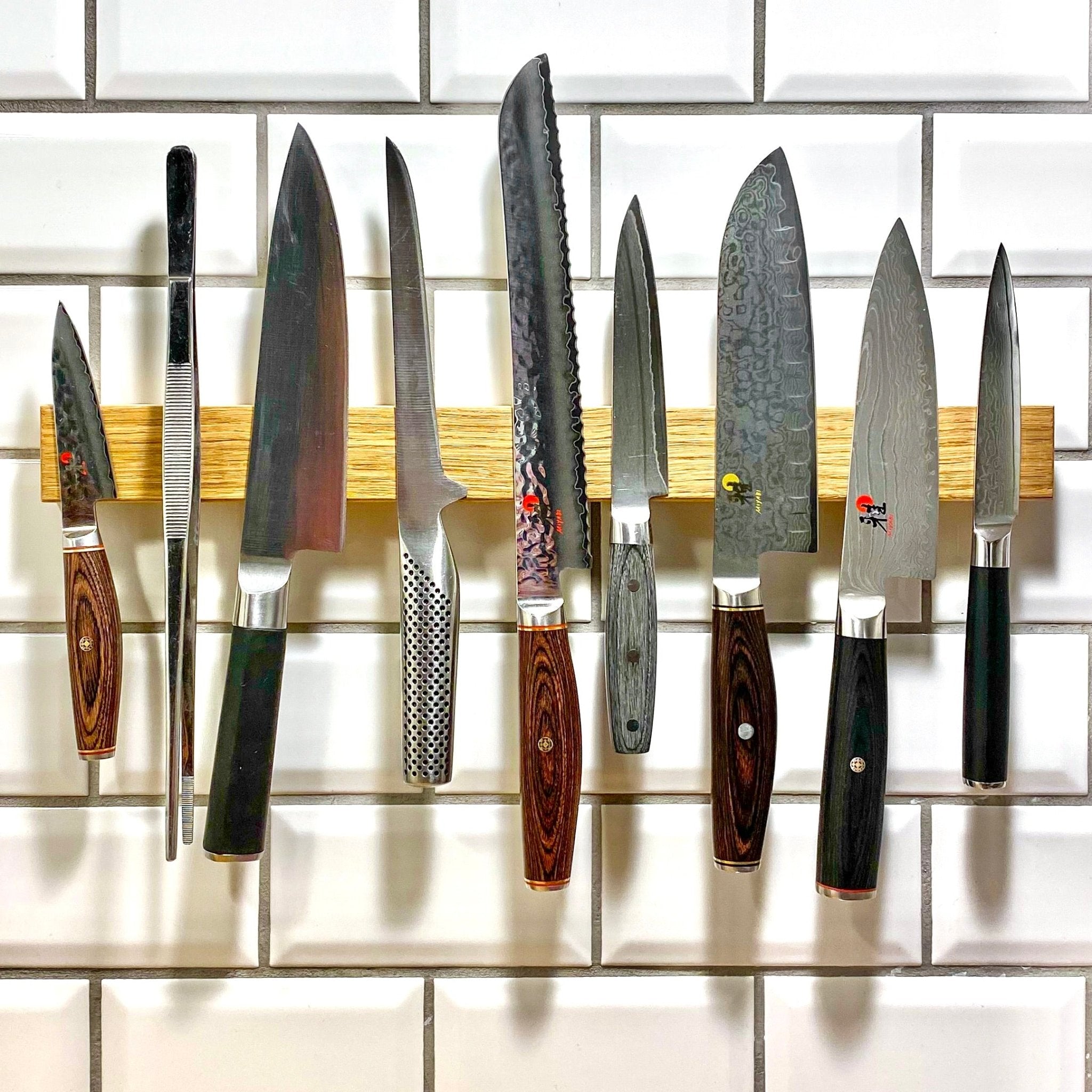
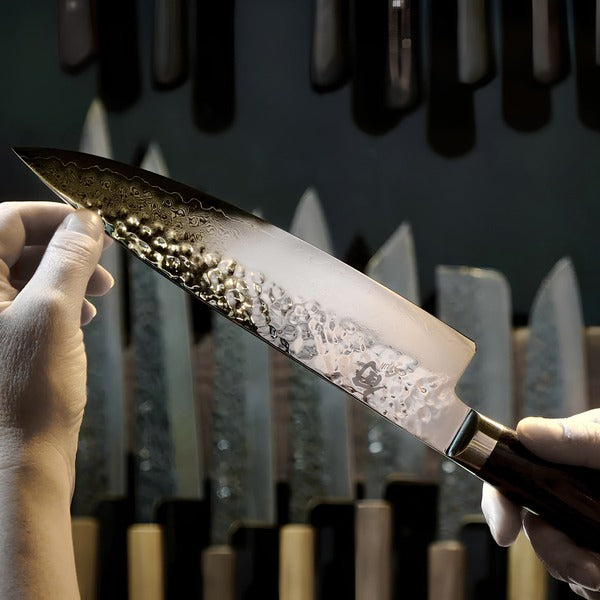
Damascus steel – what is it really? Layers, pattern and core steel
When a kitchen knife is described as “Damascus,” it’s tempting to use the number of layers as a measure of quality. 33 layers, 67 layers, or even more sounds like a technical ranking. It’s not that simple.
On many modern kitchen knives, the visible layers are a coating around a core steel that forms the actual blade. The pattern can be both beautiful and demanding to produce, but the number of layers alone does not say anything certain about edge durability or sharpness.
The core steel works at the cutting edge
If the blade is built with a hard core and softer outer layers, it is the core steel that reaches all the way to the edge. Therefore, the composition and heat treatment of the steel are key information when assessing the functional side of the knife.
Two knives with the same number of decorative layers can have very different properties if the core steel, hardness and geometry are different. This is one reason why the number of layers should not stand alone in a comparison.
How does the pattern arise?
In pattern-welded steel, different steels are forged together, after which the material can be folded, twisted or machined to create patterns. After grinding, a controlled etching highlights the differences between the alloys.
Knife Steel Nerds describes how elements like nickel and other alloying elements contribute to the contrast. Carbon can also diffuse across layers during forging, so the popular notion of completely separate “hard and soft” layers is too simplistic.
Are more layers better?
Multiple layers can refine the pattern and change the visual appearance, but there is no general metallurgical rule that multiple layers provide a better edge. Testing of different Damascus combinations shows that performance depends on the specific materials and processing.
It is therefore more relevant to ask: What steel forms the edge? How is it heat treated? How thin is the geometry? And is the knife suitable for the type of work you expect?
Why choose Damascus?
A well-made Damascus blade can combine function with a craftsmanship that changes character from knife to knife. That's a legitimate reason to choose it. You just don't need to explain the aesthetics with technical properties that it doesn't necessarily create.
The short answer
See Damascus as a construction and visual craftsmanship – not as a quality stamp in itself. A good knife is the result of the total system: steel, heat treatment, geometry, sharpening and execution.
See Japanese kitchen knives in different steel constructions . Also read about HRC and the hardness of the steel .
Convenient to remember
Another useful distinction is between san-mai construction and multi-layer cladding. In san-mai, a hard core is sandwiched between two outer layers, while many modern Damascus blades have multiple layers of outer skin surrounding a similarly cutting core. Either approach can produce good knives. The layers can partially protect a reactive core and affect the mechanical construction of the blade, but again the outcome depends on the actual materials. If a knife is marketed with a high ply count, look for the manufacturer to also list the core steel and hardness. This is a sign that the specification is describing function as well as aesthetics. A ply count without any other information is a very limited basis for comparing two kitchen knives.
Also look at the manufacturer's recommended grinding and maintenance.
Sources and further reading
- Knife Steel Nerds: Damascus steel combinations tested
- Knife Steel Nerds: Pattern-Welded Damascus
- Knife Steel Nerds: 1084/15N20 Damascus