How to make Japanese cut crystal glass
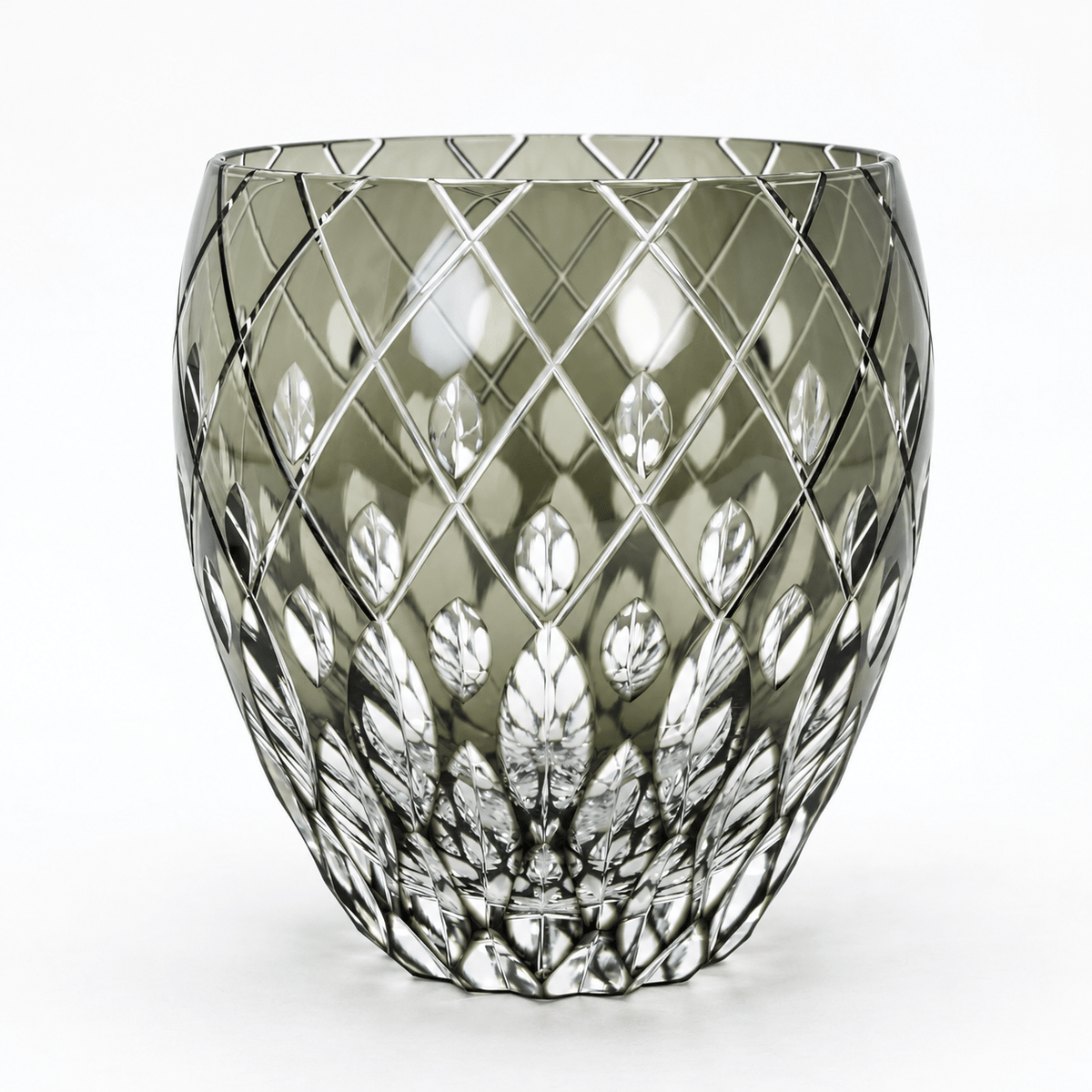
Edo Kiriko is not just glass with a pattern applied to the surface. The decoration is created by physically grinding and cutting the glass so that the light is refracted in the facets and – on colored overlay glass – the clear layer beneath the color becomes visible.
The technique has its roots in Edo in the 19th century and is now officially recognized as a traditional Japanese craft. The exact process varies between workshops, but the combination of shaping, marking, grinding and finishing is common.
First, the glass body itself must be manufactured
Kagami describes both mold blowing and free blowing in the production of crystal glass. In overlay items, a clear layer is combined with a colored layer, which can later be cut through. This places high demands on uniformity, because the glass must subsequently withstand very precise processing.
The proportions, wall thickness and symmetry of the glass are thus part of the foundation for the finished cut.
The pattern is marked before sanding.
Geometric patterns require fixed reference points. The craftsman therefore typically marks lines or a grid on the workpiece to help position subsequent cuts. In complex patterns, small deviations are visible because the lines meet repeatedly around the glass.
It is precisely this combination of repetition and hand control that gives each piece a discrete individual character.
Grinding wheels create different profiles
Kagami describes several types of grinding, including V-shaped, convex, hollow and flat cuts. By choosing the wheel profile and controlling the angle and depth of contact, the craftsman can build up the pattern step by step.
On overlay glass, the cut reveals the clear glass beneath the layer of color, creating the striking contrast associated with much Edo Kiriko.
Finish and polishing determine the light
After the rough cut, the surface is finely worked to give the desired clarity to facets and edges. Kagami also uses copper wheel engraving for other forms of detailed decoration. Each tool leaves its own unique expression.
The finished result is therefore assessed not only on the complexity of the pattern, but on proportion, precision, surface and how the light works through the crystal.
The short answer
The special thing about cut Japanese crystal lies not in one machine or one pattern, but in the chain of precise choices: the glass body, the marking, the grinding wheel, the hand pressure and the final finish. It is what makes the facets come alive in the light.
Read more about Edo Kiriko . Read the story of Kagami Crystal .
Convenient to remember
Nor should the density of the cut pattern be confused with quality alone. A relatively simple pattern may require great precision if long lines are to meet cleanly and symmetrically. Conversely, a very dense pattern can hide small variations but place great demands on time and repetition. Traditional Edo Kiriko patterns often have names and cultural associations, but modern workshops also combine them freely. When assessing a piece of glass, look at the transitions between cuts, uniform depth, polish and how the pattern follows the shape of the glass. On overlay glass, the boundary between the colored and clear layers is particularly revealing: controlled cuts provide sharp, clear contrasts without random bleed-through in the pattern.
It is also worth seeing the glass in both direct and soft light. The deep facets, the transition between colored and clear glass and the final polishing become more apparent when the glass is turned. The optical effect is part of the design, not just a consequence of the decoration.
Sources and further reading
- Kagami: Crystal Glass Manufacturing and Cutting
- Kagami: Edo Kiriko
- Edo Kiriko Cooperative Association: History and Craft
- Edo Kiriko Cooperative Association: English introduction