Linen vs. cotton – what is best for kitchen textiles?
Linen and cotton are often compared as if one fiber is going to win. That doesn’t make much sense. The two materials feel different, handle moisture differently, and lend themselves to different textile constructions – and the weave, weight, and finishing can be just as crucial as the fiber itself.
For the kitchen and dining table, we therefore do not use the question “what is best?” without first asking: for what?
Flax – crisp, strong and effective for moisture
Flax fibers come from the flax plant. Based on textile tests, the Alliance for European Flax-Linen & Hemp highlights, among other things, the material's ventilation, water vapor transport and ability to quickly absorb and disperse liquid moisture. Recent textile research similarly describes linen as a material with good moisture-management and heat-conducting properties.
That's part of the reason why linen works so well in tea towels and textiles around the kitchen: the material can absorb moisture, spread it over a larger surface area, and dry efficiently, depending on the weave.
Linen also has a crisper, more structured feel than most cotton textiles. It softens with washing and use without losing its character.
Cotton – softer from the start
Cotton is also a cellulose fiber, but is typically felt softer and more pliable when new. The material can be spun and woven in very different qualities – from fine, smooth tablecloths to thick terry textiles.
For textiles where softness and volume are a priority, cotton has a natural strength. For example, tea towels with more volume, napkins or textiles where a smoother and less rustic feel is desired.
Which dries the fastest?
The construction plays a big role here. A thin linen dishcloth may dry faster than a heavy cotton textile, but a dense and heavy linen weave can naturally hold more moisture than an ultra-light cotton weave.
The properties of the fiber give linen a strong starting point for moisture transport, but grammage, yarn and weave structure must be considered. Therefore, “linen always dries faster” is too categorical.
Tea towels: what would we choose?
For glassware, tableware and everyday kitchen work, many prefer linen or linen blends due to its firm structure and moisture management. For tasks where softer volume and large surface area are desired, cotton can be just as rational.
A new tea towel – regardless of fiber – may also have residues from finishing that affect its initial absorbency. Washing before first use is therefore a good idea.
Tablecloths and napkins
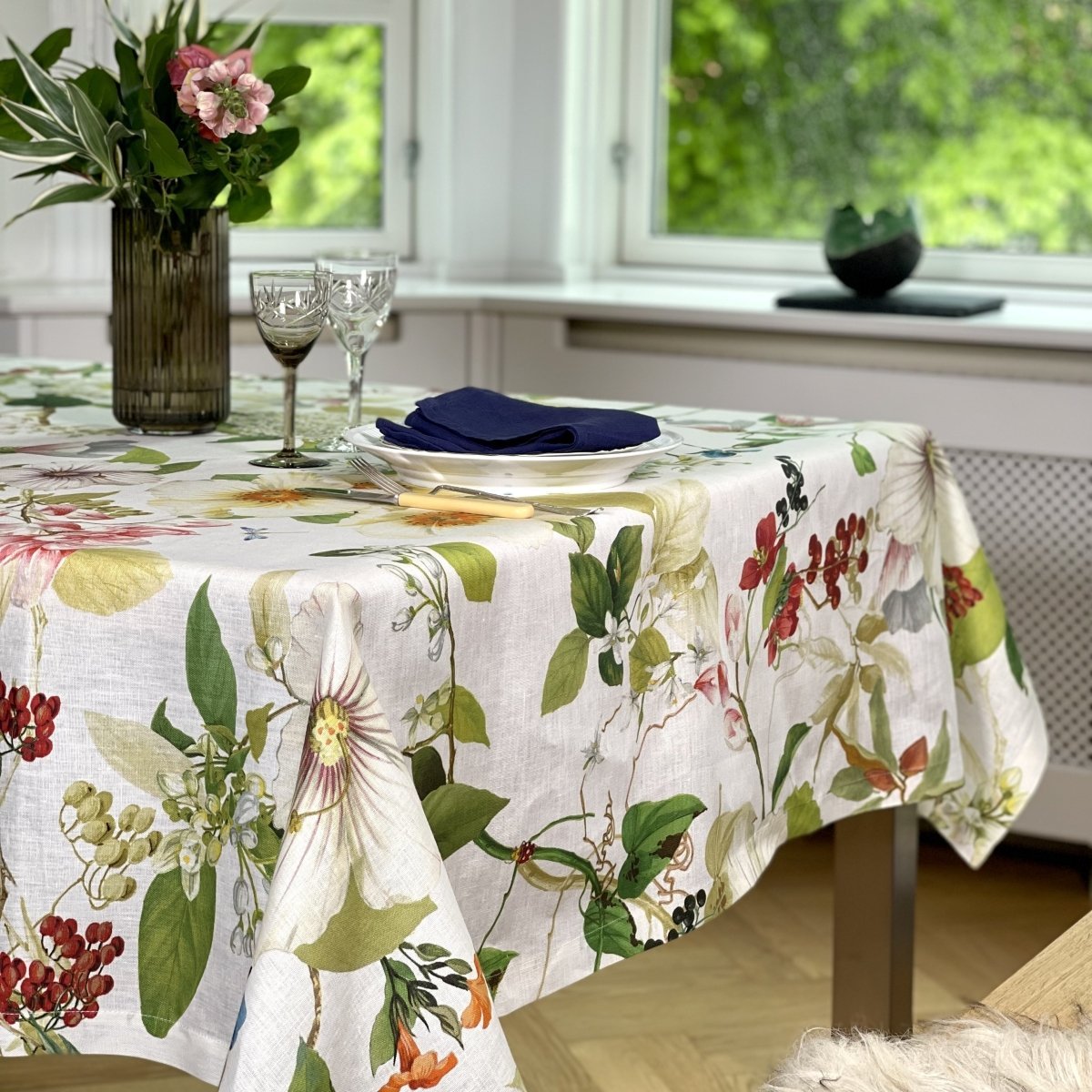
Here the choice is largely aesthetic. Linen has natural folds and a vibrant drape, which is exactly what many desire. Cotton can provide a smoother, more uniform surface and is available in a huge range of weaves and prints.
A quality tablecloth should not be judged by the fiber name alone. Also look at the fabric's weight, density, color fastness, weave, and how the manufacturer has intended the use.
Which is most sustainable?
That question cannot be answered seriously with the words linen or cotton alone. Environmental impact depends on cultivation, geographical origin, water and chemical consumption, spinning, weaving, dyeing, transport, lifespan and how the textile is washed over many years.
We therefore prefer not to call one fiber universally “greener.” A textile that is well made, lasts a long time, and can withstand repeated washing has a different life cycle than a product that is quickly discarded.
The practical conclusion
Choose linen if you like a more structured surface, vibrant folds and strong moisture transport properties.
Choose cotton if you want a softer starting point, a wide range of variations and the possibility of fuller textile constructions.
Choose blends if you want to combine properties. A good linen-cotton blend may be more relevant than a mediocre textile made of 100 percent of one fiber.
See our selection of European home and kitchen textiles , read more about linen or see our care instructions for linen textiles .
Sources and further reading
- Alliance for European Flax-Linen & Hemp: Flax performance and properties
- Journal of Natural Fibers: research on linen textile properties