Five Reasons to Choose Linen
When choosing between natural and synthetic textiles, linen is a game changer.
While cotton Long the traditional choice for housing and clothing, linen products are rapidly gaining ground for several good reasons.
The flax plant has been cultivated for thousands of years and is one of the oldest plants used to make clothing and textiles.
Linen fabric is made from the flax plant and is 100% natural. The production is sustainable and the result is strong and fine fibers, which are spun into yarn, woven and dyed into finished fabrics.
Flax fibers are naturally thicker and stronger than other textile fibers, and are 30% thicker than cotton.
It has extreme strength and is very durable, so you don't have to worry about wear and tear - and the more you use your linen products, the softer and more beautiful they become.
Unparalleled suction power
When it comes to tackling the daily wiping routines in the kitchen and bathroom, Nothing beats the absorbency of linen.
Flax fibers are naturally much more water-absorbent than cotton, so they can both hold more liquid and absorb faster than cotton.
Linen is quick-drying and stain-resistant, so linen dishcloths and towels are excellent in the kitchen for drying glass and giving silver and crystal a beautiful shine.
Linen also feels wonderfully cool against the skin and is therefore super suitable for both clothing and wiping the body after a bath.
If you're going to the beach on a sunny summer day, a thin linen textile is the most cooling and sun-protective friend you can bring.
Quick-drying and hygienic
The exceptional moisture-wicking properties of linen fibers mean they dry much faster than cotton.
The quick-drying property helps prevent bacterial growth and ensures that your tea towels, towels and dishcloths remain fresh and hygienic.
With linen textiles, you can say goodbye to the slightly earthy and musty smell that accompanies cotton dishcloths, tea towels and towels.
Durability and longevity
Linen textiles are known for their extreme durability. Linen fibers are strong and tough when dry - but when wet they become even stronger and tougher.
This means your textiles can withstand countless cycles in the washing machine without losing their integrity. They resist abrasion, fraying and colour fading, making them a long-term and sustainable investment.
The environmentally friendly choice
Linen tea towels are an environmentally conscious and sustainable choice. The flax plant requires minimal water, pesticides and synthetic fertilizers to grow.
The production process of flax textiles is far more sustainable than cotton, which is dependent on more resource-intensive cultivation and production methods.
Timeless style
Linen textiles exude a timeless and sophisticated aesthetic. The natural texture and subtle sheen of linen bring makes the fabric vibrant and elegant.
Linen's neutral color palette fits seamlessly into all environments - from rustic farmhouse to modern and minimalist interior design.
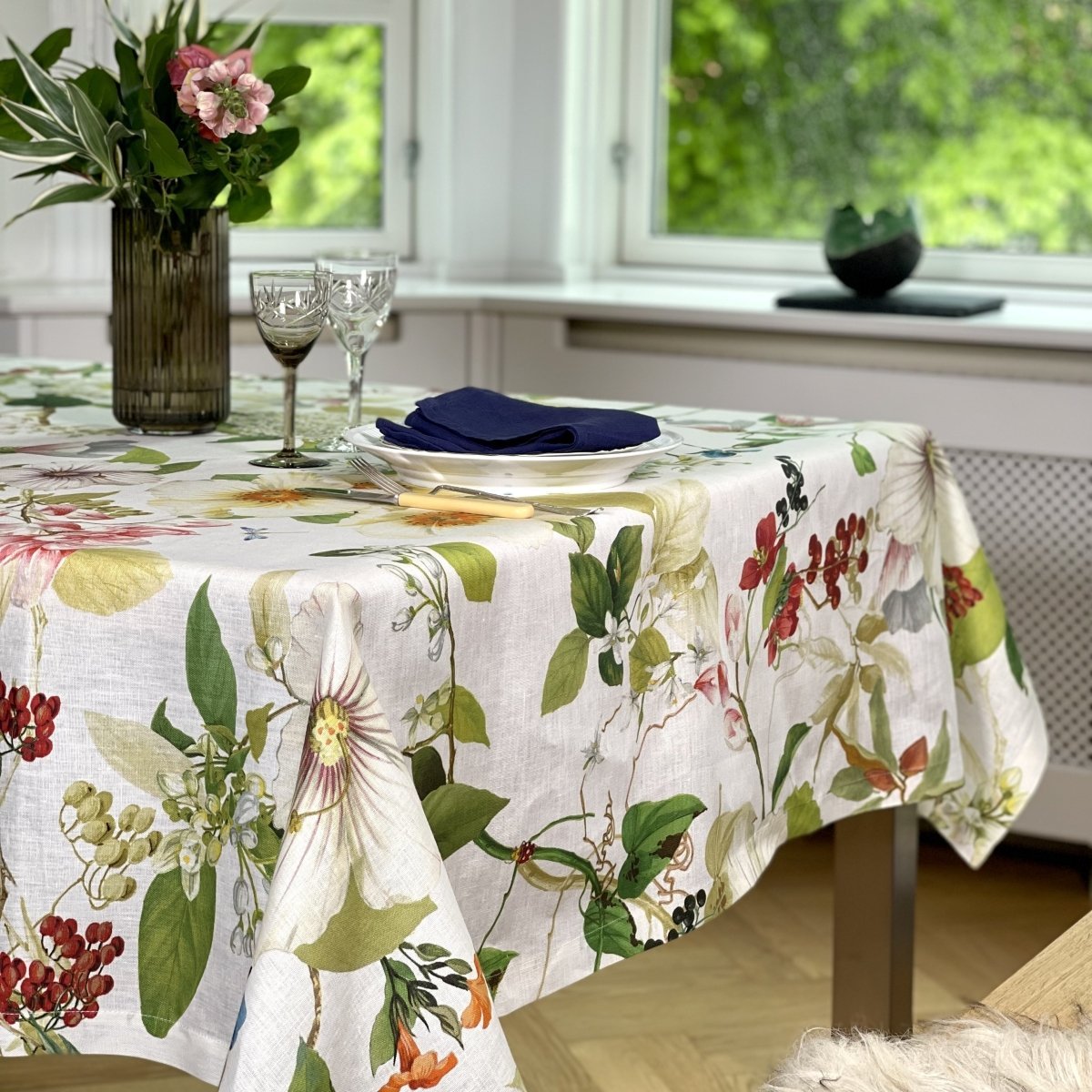
Therefore, linen should be your first choice, whether it's clothing, blankets, accessories, tablecloths, tea towels, dishcloths or towels.
The history of flax
Already in the Stone Age, flax could be processed in Europe, although it was mostly used for things like rope, fishing nets and the like.
Clothing was not that developed at that time. Almost no one had thought about the tablecloth, let alone the napkin. In ancient Egypt, people began to useEnjoy beautiful and cool linen clothes.
Linen was the only material allowed in priestly robes, and the mummies were wrapped in fine linen bandages, many of which are still preserved.
From Egypt, knowledge spread to Babylon, which in ancient times was the center of the "flax industry", via Greece to the Roman Empire and further up into Europe. In the Roman Empire, there were large flax spinning mills in ancient times in, for example, Ravenna and Vienne, which were under the strict control of the "procuratores linificiorum", which says something about the importance attached to the material. In the Nordic countries, we have been able to prepare flax at least since the Bronze Age.
Well into the 16th century, the flax was strung on a goldsmith's loom, a practical tool that you can still see oriental women mastering with virtuosity.
Around 1530, the spinning wheel came along and accelerated flax production even further. Flax processing was a craft for a long time. When machines came along in the late 18th century, so did flax's worst competitor - cotton.
Better machines were introduced, which were also suitable for the linen industry. In 1805, Joseph Marie Jacquard designed his epoch-making machine for pattern weaving, which, among other things, gave the old, fine damask weaving new possibilities.
Linen has faced stiff competition from simpler and cheaper materials, and more than once it was thought that it would disappear altogether. Linen's quality and aesthetic value have proven to survive all "new products", including the synthetic fibers of recent years.
Fortunately, it now appears that flax is entering a new era of glory – in a world moving back towards sustainability and quality awareness.