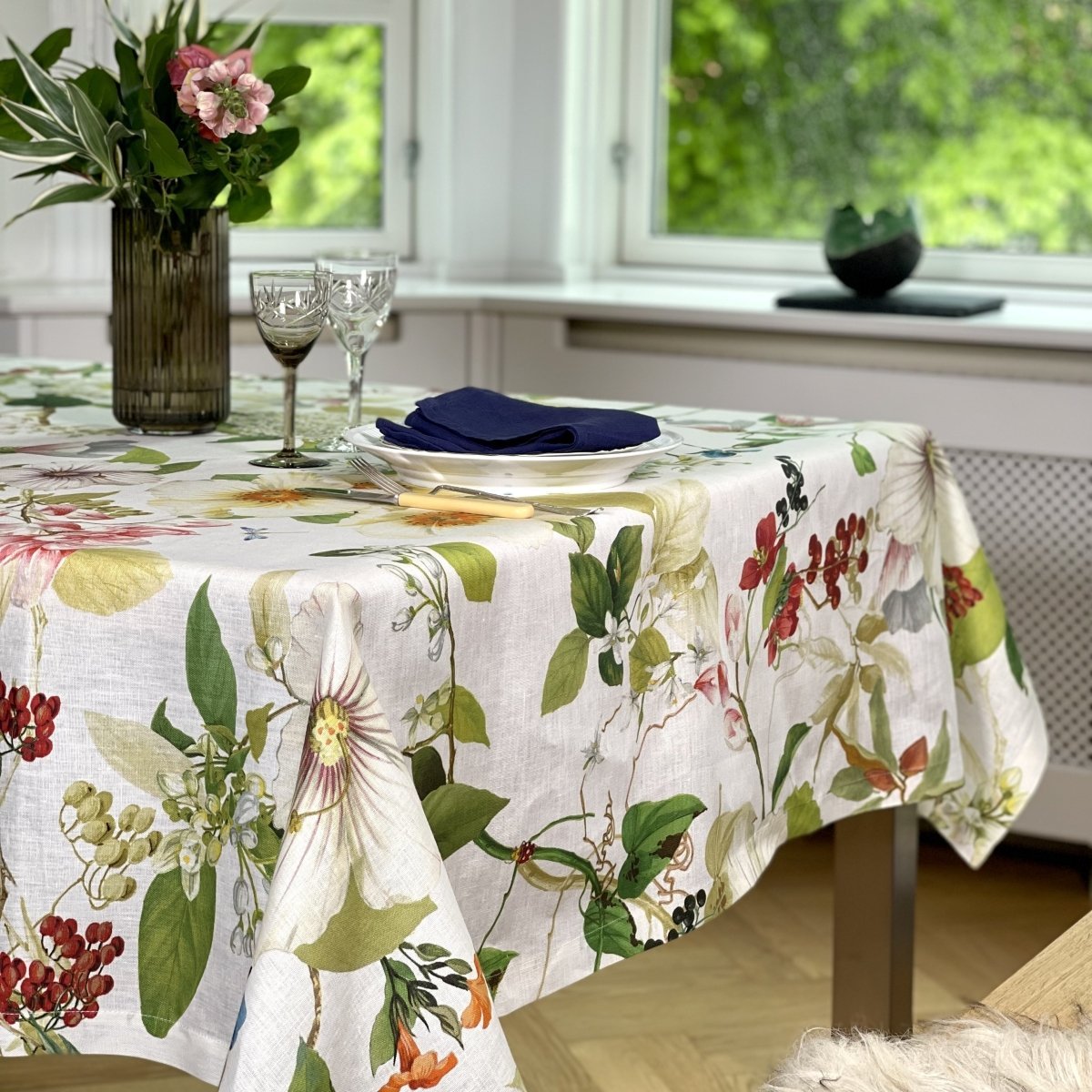
About Linen Textiles from Klässbols
Denmark has 'Georg Jensen' - Sweden has 'Class ball'
Klässbols linen weaving mill is a Swedish family business that dates back to the late 19th century.
The textiles represent the finest in weaving art and premium quality.
Since the 1970s, Klässbols Linneväveri has had the honor of supplying the Swedish royal family with exclusive tablecloths in the form of hand-woven tablecloths and napkins, royal tablecloths, furniture fabrics, bolster fabrics and curtains.
In addition, Klässbols Linneväveri has supplied specially designed tablecloths and napkins for the annual Nobel Festival for 30 years.

The family collaborates with nationally and internationally recognized designers and has received several design awards.
Many manufacturers choose to weave their textiles in very wide and long strips which are subsequently cut open, folded over and then the edges are sewn with a regular stitch.
Klässbols weaves their products to the edge, meaning that all products are woven individually and therefore have a very beautiful and seamless look.


The history of flax
Already in the Stone Age, flax could be processed in Europe, although it was mostly used for things like rope, fishing nets and the like.
Clothing was not that developed at that time. Almost no one had thought about the tablecloth, let alone the napkin. In ancient Egypt, people began to dress in beautiful and cool linen clothes.
Linen was the only material allowed in priestly robes, and the mummies were wrapped in fine linen bandages, many of which are still preserved.
From Egypt, knowledge spread to Babylon, which in ancient times was the center of the "flax industry", via Greece to the Roman Empire and further up into Europe. In the Roman Empire, there were large flax spinning mills in ancient times in, for example, Ravenna and Vienne, which were under the strict control of the "procuratores linificiorum", which says something about the importance attached to the material. In the Nordic countries, we have been able to prepare flax at least since the Bronze Age.
Well into the 16th century, flax was stretched on a goldsmith's loom, a practical tool that you can still see oriental women mastering with virtuosity. Around 1530, the spinning wheel came along and accelerated flax production even further. Flax processing was a craft for a long time. When machines came along at the end of the 18th century, so did flax's worst competitor - cotton. Better machines came along, which were also well-suited to the flax industry. In 1805, Joseph Marie Jacquard designed his epoch-making machine for pattern weaving, which, among other things, gave the old, fine damask weaving new possibilities.
Linen has faced stiff competition from simpler and cheaper materials, and more than once it was thought that it would disappear altogether. The quality and aesthetic value of linen have proven to survive all "new products", including the synthetic fibers of recent years. Now it seems that linen is entering a new era of glory - in a world returning to quality thinking and beautiful things. Linen is a material without equal - in the hands of skilled professionals.

About flax
The long fiber of flax is well suited for weaving, and its use can be traced back nine thousand years. In the 18th century, there were several famous Nordic damask weavers and the blue-flowering flax fields were breathtakingly beautiful in the countryside. Eventually, cotton took over as the most common textile fiber, and the labor-intensive flax fell into the shadows. Today, hay is grownr no longer in the Nordic countries, except to a limited extent, but linen fabrics have had a renaissance. Awareness of nature has gained a strong foothold and more and more people appreciate the tradition and the unique properties of linen.
The flax fiber has extreme strength and absorbency. The fabric is quick-drying and dirt-repellent. If you spill liquid on the fabric, it is absorbed immediately. Flax cloths are excellent in the kitchen for drying glasses and giving silver and crystal a beautiful shine. Flax also feels wonderfully cool against the skin.
Washing and care
Linen textiles should be washed at 60°C, but difficult stains may require a higher temperature, but not higher than 80°C. Linen is a hard-wearing and durable material and best of all a good choice for the environment. Always expect a shrinkage of around 5-7% when washing linen fabric the first time.
A fine linen fabric that has been properly treated has a high, beautiful sheen and a cool, smooth surface.
1. Soaking
Soak the new linen in lukewarm water for at least 20-30 minutes before washing to avoid wrinkles, but also to contribute to more water in the washing machine.
2. Detergent
We recommend detergents for colored laundry for all our textiles or detergents without bleach.
3. Water-rich program
All new linen will shed excess fibers at first, which should be rinsed out in the wash. Set the washing machine to the program with the most generous amount of water. Do not wash with the eco program, as it uses little water.
Wash at 60°C and wash linen separately and not with other materials, as excess linen fibers can settle on the clothes as lint.
If you have a difficult stain that requires a higher temperature, you can increase the temperature, but never above 80° C, because the linen can then lose elasticity, shine and strength.
4. Drying - spinning and tumble drying
When spinning, only use low speed (400-800), eliminate spinning completely if possible. At high speeds, the fibers can break, which leads to a deterioration in quality and the formation of more excess fibers. When the wash is finished, clean the door of the washing machine to remove fluff.
Hang to dry after washing. Natural and colored linen should not be dried in strong sunlight.
We do not recommend tumble drying. However, the 'BADA' towels can be tumble dried at a low temperature if desired.
5. Ironing
Stretch the damp linen after washing and hang to dry. If you wish to iron your fabric, do so while it is damp and with a warm iron (three dots). If you have a cold iron, you will need to iron the linen several times to achieve maximum shine.