About Moritaka Knives
The knives from the Moritaka family are probably the ones whose history can be traced back the furthest. The story begins all the way back in 1293, when the master blacksmith with the colloquial name Kongouhyoueminamotono Moritaka forged swords for the Buddhist monk at Mt. Houman in Dazaifu, Fukuoka.
For the next 13 generations, the tradition of producing swords for the monks continued, and these swords went on to gain a rather unique status in the liberation struggle.
As time passed from weapon production, the focus shifted to the kitchen knives we know today. A knife from Moritaka is forged according to the traditions and with the techniques known from the iconic katanas.
Today, Hamone Moritake - the master blacksmith at Moritaka - also occasionally forges katana swords, but the vast majority of production ends up in kitchen knives. A knife from Moritaka is also quite recognizable.
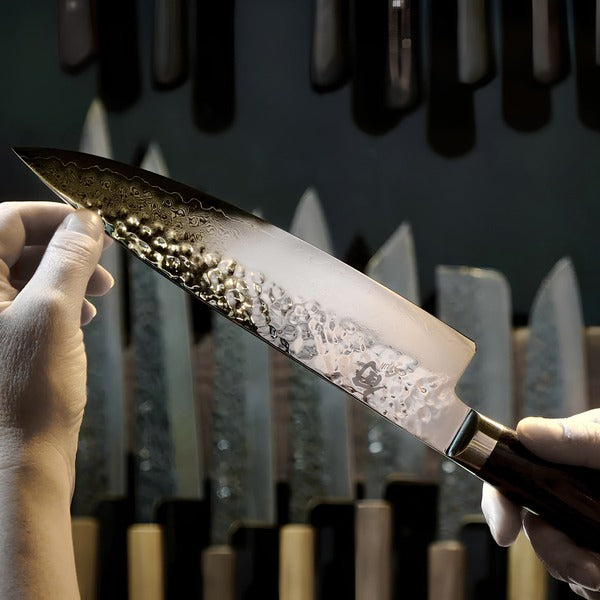
Most are forged in blue steel, especially often in the alloy aogami-2. The knives also have a relatively rustic appearance because the blade surfaces are not ground completely smooth, and because all the knives are given a so-called kurouchi treatment.
This treatment is what gives the knives their dark color. It is an oil that is applied to the metal when it is hot. This also means that it is not a permanent treatment. It will develop a patina, and the oil will disappear over time as you wash the knife after use.
Moritaka enjoys a special status with us, as we are very fond of small family forges that make things that are a little out of the ordinary.
Moritaka is also among the sharpest knives we carry, but that also means that you as the owner must take special care of the knife.