Les Céramiques de Lussan — ceramics with roots in a southern French village
Les Céramiques de Lussan — ceramics with roots in a southern French village
Behind every piece of ceramics from Les Céramiques de Lussan lies a story that spans more than half a century — from a young Swiss artist's encounter with the southern French light to an internationally recognized workshop rooted in a village most people have never heard of.
Heidi Caillard and the beginning
Heidi Caillard was born in 1932 in Basel, Switzerland. After studying fine arts at the Basel School of Arts and Crafts and then ceramics at the Lausanne School of Ceramics, she settled in 1968 in Blauzac — a small village near Uzès in Languedoc — where she opened a ceramics workshop and showroom. One of her clients was Daniel Caillard, a soldier stationed at the Garon air base near Nîmes. He later became her husband.
In 1971, the couple bought a completely dilapidated farmhouse in Lussan — a house that had once belonged to the ancestors of the writer André Gide. They spent ten years renovating it, and already in 1974, in the middle of the work, they moved both the workshop and the shop to Lussan, where they still live today.
Adrien and the next generation
In 1994, his son Adrien Caillard took over the business — initially to relieve Heidi, but driven by a genuine passion for the craft, he gradually became fully involved. He mastered the techniques, optimized the production process and packaging, and thus opened the doors to professional customers — without ever compromising on the manual methods that underlie each individual piece.
Participation in Maison et Objet in Paris and numerous press reviews gave the small workshop from Lussan international visibility. In 2000, an additional workshop was built in the same architectural style as the original mas — an impressive wooden structure of 200 square meters of free, column-free workspace, designed by architect Daniel Sechet.
Today, a dedicated team keeps alive the quality and spirit that Heidi founded. Heidi herself still occasionally draws new pieces — despite her age.
The guinea fowl — an icon from Lussan
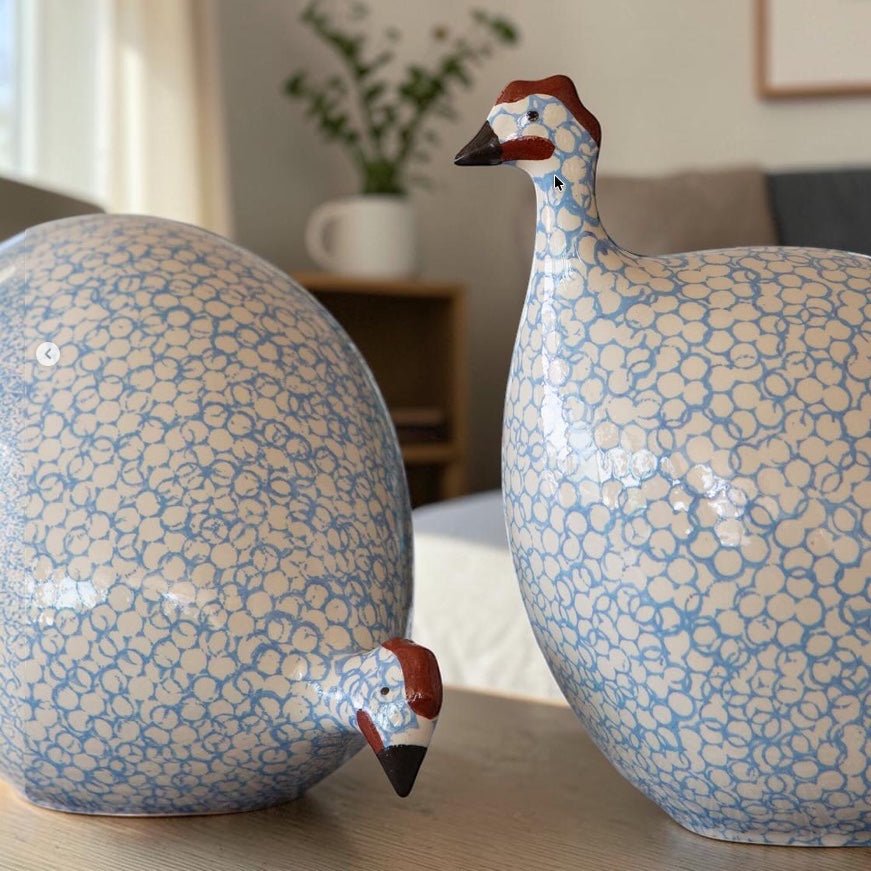
Adrien's most famous creation is undoubtedly the guinea fowl. To many today, it is simply the Lussan guinea fowl . The bird took shape in Heidi's imagination during her school days — it literally lived in the garden — but the path to the final sculpture required long days of sketching, building and breaking down, over and over again, until the proportions were exactly right. The result is a stylized, expressive figure with an almost archetypal calm about it.
The guinea fowl is produced in several sizes — from the smallest model of 17 cm to the large one of 24.5 cm — and in a wide range of color combinations, from classic gray with sky blue to electric blue with black and frog green with burgundy. Each bird is handmade, and colors and spot patterns naturally vary from piece to piece.
Ceramics with origin
Les Céramiques de Lussan is everything that the term objets with origin covers: a product with a specific origin, created by identifiable people, in one specific place, with techniques that have been handed down and developed over generations. It is ceramics that are not made to fill a shelf, but to be present in a room.